




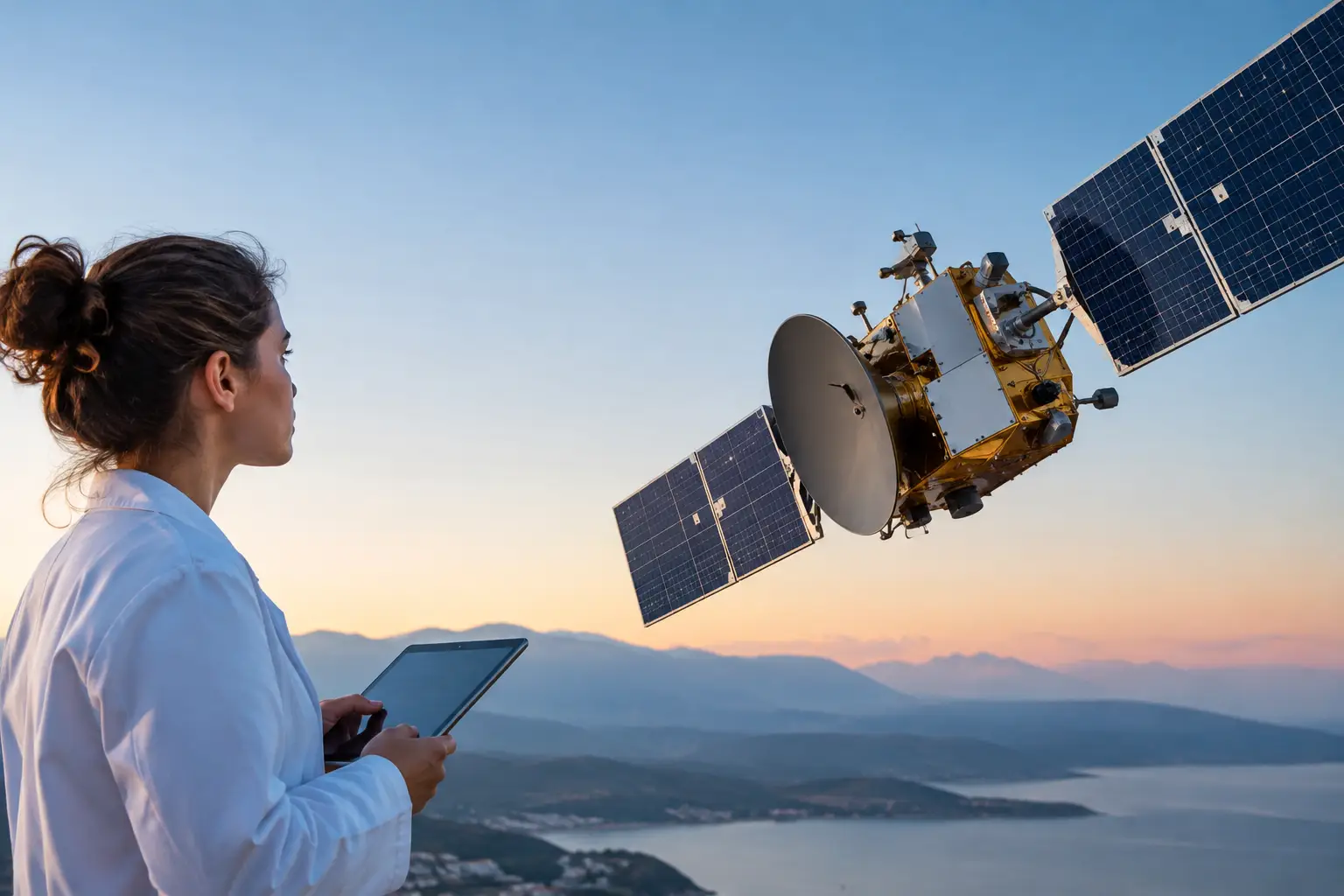
Emerging European Space Technology to Watch

07/11/2026
32
Emerging European Space Technology to Watch

A satellite image is no longer just a striking picture of Earth. For a farmer assessing drought, an insurer modeling flood exposure, or a logistics team monitoring a disrupted port, it can be operational intelligence. That shift is at the heart of emerging European space technology: a sector moving beyond prestige missions and toward services that affect business, public infrastructure, climate resilience, and security.

Europe is not trying to recreate Silicon Valley's space playbook. Its advantage lies in a different mix: strong research institutions, deep industrial capability, public procurement, climate ambition, and a growing group of companies turning orbital infrastructure into usable products. The opportunity is real, but so are the barriers - capital intensity, fragmented markets, export controls, and a talent pipeline that still does not reflect the people space technology is meant to serve.

Why Emerging European Space Technology Matters Now

The commercial space economy is often reduced to rockets and moonshots. That is the visible part. The more immediate value sits downstream, where data, connectivity, positioning, and observation become tools for decisions on the ground.

European governments and businesses are facing overlapping pressures: extreme weather, supply-chain volatility, geopolitical risk, and demands for more secure digital infrastructure. Space-based capabilities can support each of them. Earth observation can identify methane leaks and track crop health. Satellite connectivity can provide resilience when terrestrial networks fail. Positioning and timing services underpin financial systems, transport, and emergency response more often than most people realize.

Europe also has strategic reasons to invest. Dependence on non-European launch providers, cloud platforms, or satellite networks can create vulnerabilities when political relationships change. Programs such as Galileo, Copernicus, and IRIS2 signal a broader push for autonomy. That does not mean Europe will operate in isolation. It means policymakers and businesses increasingly want credible European options.

The Technologies Building Momentum

Earth observation becomes a business tool

Earth observation is one of Europe's strongest space segments. Copernicus has helped establish a powerful public data foundation, while private companies are building specialized services on top of satellite imagery and sensor data.

The next phase is less about collecting more images and more about making them actionable. Synthetic aperture radar can see through clouds and at night, which is useful for monitoring floods, maritime activity, and infrastructure. Hyperspectral imaging can distinguish materials and measure environmental indicators in greater detail. AI helps turn large, complex datasets into alerts that a non-space specialist can use.

For operators and founders, the question is not whether a dataset comes from space. It is whether it lowers a decision-making cost. A climate-risk product that helps an insurer price exposure may be more commercially valuable than a technically impressive image archive. The winners will be teams that understand both orbital data and the industry workflow they are trying to improve.

Smaller satellites, more focused missions

Europe's NewSpace companies are helping change the economics of access to orbit. Small satellites and constellations make it possible to deploy targeted missions more quickly than traditional large spacecraft programs, although lower cost does not automatically mean lower complexity.

Companies such as Finland's ICEYE have demonstrated demand for radar imaging, while France's Unseenlabs has focused on maritime radio-frequency detection. Across the continent, firms are developing satellite platforms, propulsion, components, mission software, and in-orbit services. Their work is often less visible than a launch, but it is where supply chains and intellectual property are being built.

There is a trade-off. A proliferation of small satellites can create pressure on orbital sustainability, spectrum access, and space traffic management. European innovation will be judged not only by how quickly it deploys hardware, but also by how responsibly it operates it.

Launch capacity is becoming a strategic question

Launch is still the bottleneck that captures attention, and for good reason. Without reliable access to orbit, satellite plans remain presentations. European launch startups, including Germany's Isar Aerospace and Rocket Factory Augsburg, are part of a wider effort to create more flexible launch options from Europe.

The business case is difficult. Launch requires enormous upfront investment, rigorous testing, and a tolerance for failure that public institutions and investors do not always share. Established global competitors benefit from scale and frequent flight heritage. European challengers will need technical reliability, patient capital, and clear demand from commercial and institutional customers.

Still, launch matters beyond revenue. It shapes whether European satellite makers can schedule missions on their own terms and whether defense, climate, or communications projects can move at the speed their users require.

Secure connectivity is no longer a niche

Satellite communications are entering a new period, driven by demand for coverage in remote areas and resilience during crises. Europe's established satellite operators bring experience, while new constellations and direct-to-device concepts are changing expectations around connectivity.

The key distinction is between promising demonstrations and sustainable networks. Building a constellation is expensive; maintaining it, securing it, and selling capacity at margins that justify the investment is harder. Public-sector demand can help create an anchor market, especially for secure communications, but commercial adoption will depend on service quality and integration with terrestrial networks.

For Europe, connectivity is also a policy issue. The infrastructure carries questions of data sovereignty, defense readiness, and who controls essential communications when terrestrial systems are disrupted.

Where Europe Has an Edge - and Where It Does Not

Europe has world-class engineering, respected scientific institutions, and mature aerospace suppliers. It has an especially credible position in environmental monitoring, industrial hardware, and public-private missions. Its regulatory focus can also become an advantage when customers need trusted data governance and responsible operations.

But the sector remains fragmented. Founders may need to navigate national procurement systems, different funding rules, and a more conservative scale-up environment than peers in the United States. Venture capital has become more comfortable with deep tech, yet many investors still prefer software timelines to hardware realities.

That gap matters because space companies do not scale like typical SaaS businesses. They need long development cycles, specialist talent, test facilities, insurance, and often government customers before commercial revenue becomes predictable. A company with a strong technical team may still struggle if it cannot finance the years between prototype and recurring contracts.

The answer is not to force every space company into a venture-style growth narrative. Some businesses need blended finance, patient institutional capital, strategic partnerships, and procurement models that reward early innovation without lowering safety standards.

Visibility Is an Economic Issue, Not Just a Cultural One

The people building European space technology shape what it is built for. When leadership teams, engineering departments, investment committees, and expert panels draw from a narrow pool, the sector misses talent and limits the range of problems it recognizes.

Women are contributing across mission design, geospatial analytics, aerospace engineering, policy, investment, and climate applications, yet they are still too often treated as exceptions in a field that relies on multidisciplinary expertise. Visibility changes career decisions. It also changes who gets invited into founding teams, who is trusted with technical authority, and whose networks reach decision-makers.

For employers, this goes beyond polished recruitment campaigns. It means making technical leadership visible, building fair promotion paths, supporting returnships and mid-career transitions, and ensuring conference stages reflect the ecosystem as it actually is and should become. For investors and policymakers, it means looking beyond familiar founder networks when deciding whose ideas receive early credibility.

What Tech Professionals Should Watch Next

The most relevant space stories may not come from a rocket launch. Watch for Earth observation products that enter insurance, agriculture, energy, and public-sector workflows. Pay attention to procurement decisions, because they can create the first meaningful revenue for deep-tech companies. Track regulation around debris, spectrum, cybersecurity, and dual-use technology, since these rules will shape which business models can grow.

Also watch the teams connecting space expertise with commercial fluency. The sector needs engineers, but it also needs product managers who can translate a customer's operational problem, lawyers who understand data rights, marketers who can explain technical value without hype, and investors who can evaluate long timelines without demanding false certainty.

For women building careers in European tech, space should not be treated as a distant specialist corner. It is becoming part of the infrastructure behind climate technology, cybersecurity, AI, mobility, and communications. The most interesting opportunities may be in the bridges between those fields.

European space technology will earn its place not through bigger promises, but through useful systems that work when conditions on Earth get harder. That is where attention, investment, and a more representative generation of leaders can make the difference.


Recent

Breaking Tech Europe: Top 5 – Berlin Moves to Shut Huawei Out of 5G, Brussels Bets €525m on Chip Design, and Upwork Buys WorkMotion

Practical Guide to Cybersecurity Board Reporting

Oxford's FluoRok raises $30m to break China's grip on a key battery salt

Station F start-ups raise a record €2bn in 2026 as Paris campus names its Future 40

Emerging European Space Technology to Watch

07/11/2026
32
Emerging European Space Technology to Watch

A satellite image is no longer just a striking picture of Earth. For a farmer assessing drought, an insurer modeling flood exposure, or a logistics team monitoring a disrupted port, it can be operational intelligence. That shift is at the heart of emerging European space technology: a sector moving beyond prestige missions and toward services that affect business, public infrastructure, climate resilience, and security.

Europe is not trying to recreate Silicon Valley's space playbook. Its advantage lies in a different mix: strong research institutions, deep industrial capability, public procurement, climate ambition, and a growing group of companies turning orbital infrastructure into usable products. The opportunity is real, but so are the barriers - capital intensity, fragmented markets, export controls, and a talent pipeline that still does not reflect the people space technology is meant to serve.

Why Emerging European Space Technology Matters Now

The commercial space economy is often reduced to rockets and moonshots. That is the visible part. The more immediate value sits downstream, where data, connectivity, positioning, and observation become tools for decisions on the ground.

European governments and businesses are facing overlapping pressures: extreme weather, supply-chain volatility, geopolitical risk, and demands for more secure digital infrastructure. Space-based capabilities can support each of them. Earth observation can identify methane leaks and track crop health. Satellite connectivity can provide resilience when terrestrial networks fail. Positioning and timing services underpin financial systems, transport, and emergency response more often than most people realize.

Europe also has strategic reasons to invest. Dependence on non-European launch providers, cloud platforms, or satellite networks can create vulnerabilities when political relationships change. Programs such as Galileo, Copernicus, and IRIS2 signal a broader push for autonomy. That does not mean Europe will operate in isolation. It means policymakers and businesses increasingly want credible European options.

The Technologies Building Momentum

Earth observation becomes a business tool

Earth observation is one of Europe's strongest space segments. Copernicus has helped establish a powerful public data foundation, while private companies are building specialized services on top of satellite imagery and sensor data.

The next phase is less about collecting more images and more about making them actionable. Synthetic aperture radar can see through clouds and at night, which is useful for monitoring floods, maritime activity, and infrastructure. Hyperspectral imaging can distinguish materials and measure environmental indicators in greater detail. AI helps turn large, complex datasets into alerts that a non-space specialist can use.

For operators and founders, the question is not whether a dataset comes from space. It is whether it lowers a decision-making cost. A climate-risk product that helps an insurer price exposure may be more commercially valuable than a technically impressive image archive. The winners will be teams that understand both orbital data and the industry workflow they are trying to improve.

Smaller satellites, more focused missions

Europe's NewSpace companies are helping change the economics of access to orbit. Small satellites and constellations make it possible to deploy targeted missions more quickly than traditional large spacecraft programs, although lower cost does not automatically mean lower complexity.

Companies such as Finland's ICEYE have demonstrated demand for radar imaging, while France's Unseenlabs has focused on maritime radio-frequency detection. Across the continent, firms are developing satellite platforms, propulsion, components, mission software, and in-orbit services. Their work is often less visible than a launch, but it is where supply chains and intellectual property are being built.

There is a trade-off. A proliferation of small satellites can create pressure on orbital sustainability, spectrum access, and space traffic management. European innovation will be judged not only by how quickly it deploys hardware, but also by how responsibly it operates it.

Launch capacity is becoming a strategic question

Launch is still the bottleneck that captures attention, and for good reason. Without reliable access to orbit, satellite plans remain presentations. European launch startups, including Germany's Isar Aerospace and Rocket Factory Augsburg, are part of a wider effort to create more flexible launch options from Europe.

The business case is difficult. Launch requires enormous upfront investment, rigorous testing, and a tolerance for failure that public institutions and investors do not always share. Established global competitors benefit from scale and frequent flight heritage. European challengers will need technical reliability, patient capital, and clear demand from commercial and institutional customers.

Still, launch matters beyond revenue. It shapes whether European satellite makers can schedule missions on their own terms and whether defense, climate, or communications projects can move at the speed their users require.

Secure connectivity is no longer a niche

Satellite communications are entering a new period, driven by demand for coverage in remote areas and resilience during crises. Europe's established satellite operators bring experience, while new constellations and direct-to-device concepts are changing expectations around connectivity.

The key distinction is between promising demonstrations and sustainable networks. Building a constellation is expensive; maintaining it, securing it, and selling capacity at margins that justify the investment is harder. Public-sector demand can help create an anchor market, especially for secure communications, but commercial adoption will depend on service quality and integration with terrestrial networks.

For Europe, connectivity is also a policy issue. The infrastructure carries questions of data sovereignty, defense readiness, and who controls essential communications when terrestrial systems are disrupted.

Where Europe Has an Edge - and Where It Does Not

Europe has world-class engineering, respected scientific institutions, and mature aerospace suppliers. It has an especially credible position in environmental monitoring, industrial hardware, and public-private missions. Its regulatory focus can also become an advantage when customers need trusted data governance and responsible operations.

But the sector remains fragmented. Founders may need to navigate national procurement systems, different funding rules, and a more conservative scale-up environment than peers in the United States. Venture capital has become more comfortable with deep tech, yet many investors still prefer software timelines to hardware realities.

That gap matters because space companies do not scale like typical SaaS businesses. They need long development cycles, specialist talent, test facilities, insurance, and often government customers before commercial revenue becomes predictable. A company with a strong technical team may still struggle if it cannot finance the years between prototype and recurring contracts.

The answer is not to force every space company into a venture-style growth narrative. Some businesses need blended finance, patient institutional capital, strategic partnerships, and procurement models that reward early innovation without lowering safety standards.

Visibility Is an Economic Issue, Not Just a Cultural One

The people building European space technology shape what it is built for. When leadership teams, engineering departments, investment committees, and expert panels draw from a narrow pool, the sector misses talent and limits the range of problems it recognizes.

Women are contributing across mission design, geospatial analytics, aerospace engineering, policy, investment, and climate applications, yet they are still too often treated as exceptions in a field that relies on multidisciplinary expertise. Visibility changes career decisions. It also changes who gets invited into founding teams, who is trusted with technical authority, and whose networks reach decision-makers.

For employers, this goes beyond polished recruitment campaigns. It means making technical leadership visible, building fair promotion paths, supporting returnships and mid-career transitions, and ensuring conference stages reflect the ecosystem as it actually is and should become. For investors and policymakers, it means looking beyond familiar founder networks when deciding whose ideas receive early credibility.

What Tech Professionals Should Watch Next

The most relevant space stories may not come from a rocket launch. Watch for Earth observation products that enter insurance, agriculture, energy, and public-sector workflows. Pay attention to procurement decisions, because they can create the first meaningful revenue for deep-tech companies. Track regulation around debris, spectrum, cybersecurity, and dual-use technology, since these rules will shape which business models can grow.

Also watch the teams connecting space expertise with commercial fluency. The sector needs engineers, but it also needs product managers who can translate a customer's operational problem, lawyers who understand data rights, marketers who can explain technical value without hype, and investors who can evaluate long timelines without demanding false certainty.

For women building careers in European tech, space should not be treated as a distant specialist corner. It is becoming part of the infrastructure behind climate technology, cybersecurity, AI, mobility, and communications. The most interesting opportunities may be in the bridges between those fields.

European space technology will earn its place not through bigger promises, but through useful systems that work when conditions on Earth get harder. That is where attention, investment, and a more representative generation of leaders can make the difference.

Recent

© European Tech On Heels - 2026
Made with
Web Wings