




Breaking Tech Europe: Top 5 – sennder Lines Up €228m, VectorY Raises €74.5m Against ALS, and Benchmark Bets $30m on Rebuilding the CPU
12/11/2026
12
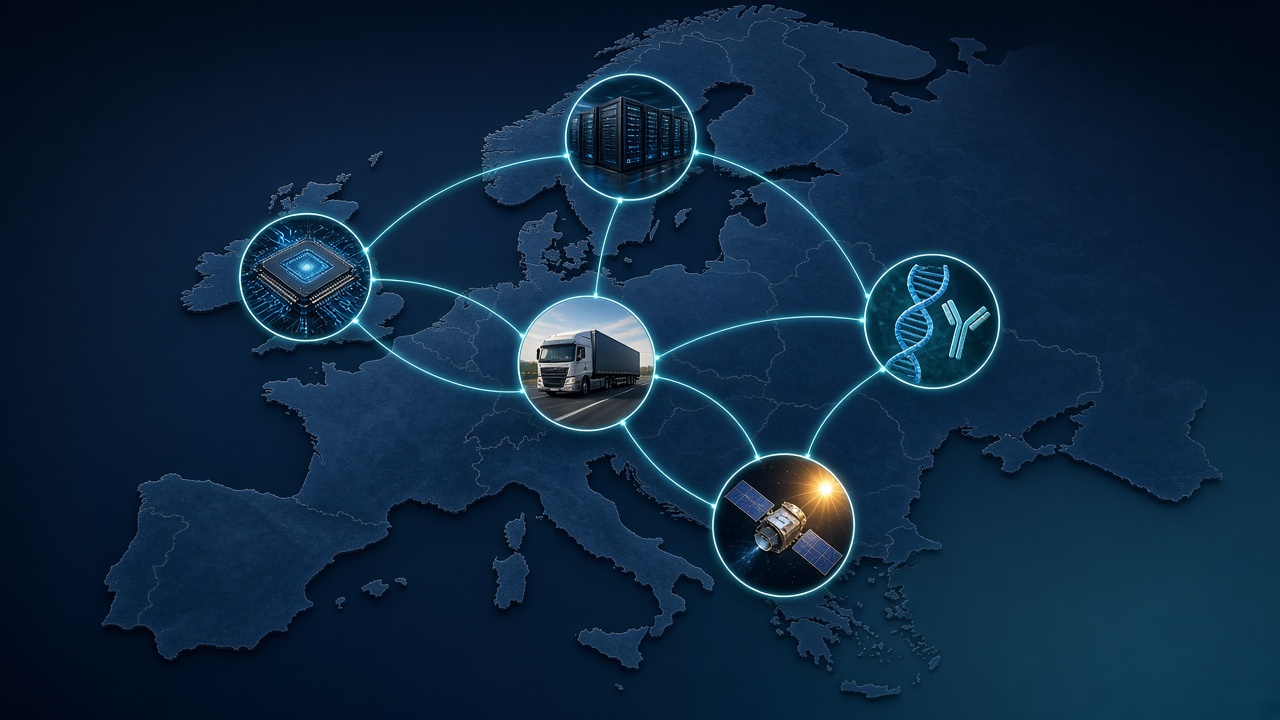
Illustrated map of Europe linking a computer chip, server racks, a freight truck, a satellite with solar panels and a DNA helix

Germany's sennder lines up €228m after turning profitable, Brussels and Amsterdam back VectorY's €74.5m push against ALS, and Benchmark makes a $30m bet on a British attempt to rebuild the CPU. Copenhagen tops up its national AI supercomputer, and Turin's Revolv Space raises money to mass-produce satellite parts. This is the EuropeanTechOnHeels Top 5 for Thursday 12 November 2026.

1. sennder secures €228m in debt and equity as Berlin's freight forwarder eyes more acquisitions

sennder, Scania, Poste Italiane, Coface, EIB: €228m in total, made up of €155m in facilities and €73m in equity, gives Berlin's digital road-freight forwarder fresh firepower for more takeovers across Europe.

The package has three debt parts: a €100m non-recourse factoring line with credit insurer Coface, a €40m facility from the European Investment Bank and a €15m supply-chain finance programme with cflox and Deutsche Bank. The €73m of equity came only from existing shareholders, led by Scania and Poste Italiane, and was raised over two years rather than in one round, the company said. Chief executive David Nothacker told Börsen-Zeitung that he still sees plenty of room for M&A in the DACH region, Spain, Poland and Romania. He also said the roughly €400m of equity raised so far is enough to keep the buy-and-build strategy going.

Why it matters: The deal comes three weeks after sennder said it had turned IFRS EBITDA-positive each month and expects about €1bn in revenue for 2026. That makes it a rare European logistics-tech unicorn borrowing against its own profits rather than on venture hype. No valuation was disclosed.

2. VectorY Therapeutics raises €74.5m, with the EIB and Invest-NL backing its ALS gene therapy

VectorY, Angelini Ventures, Invest-NL, EIB, Eli Lilly: €74.5m ($83.5m) will carry the Amsterdam biotech's lead ALS drug through the final readout of a Phase 1/2 trial that has grown from 12 to 36 patients.

The package includes a €30m convertible loan from the European Investment Bank, backed by the EU's InvestEU programme, and €7m from Dutch state investor Invest-NL. Returning backers include Forbion, EQT Life Sciences and Eli Lilly, European Biotechnology Magazine reports. The magazine puts VectorY's total reported funding at €234.5m since 2021. The money also supports VTx-003 for Huntington's disease. VectorY's lead candidate, VTx-002, targets the TDP-43 protein and remains investigational.

Why it matters: Public lenders are now playing a big part in European biotech rounds. Here, EU and Dutch public money (€37m) makes up almost half of the new financing, a sign of how hard late-stage neuroscience capital is to find from private investors alone.

3. Tendrils Compute raises $30m from Benchmark to rebuild the CPU, with Britain's Sovereign AI Fund on board

Tendrils Compute, Benchmark, UK Sovereign AI Fund: a $30m seed round backs a UK chip start-up designing a processor with thousands of parallel cores. It has not yet shown any silicon or benchmarks.

Benchmark led the round, with Visionaries Club, FR8, Antimatter, Cloudberry VC, Conviction, Embassy Ventures and SV Angels joining. Benchmark general partner Jack Altman joins the board, The Cap Table reports. The design is built on "interaction nets", a model in which independent operations run at the same time. It is paired with Vine, an open-source programming language. The Cap Table notes that Tendrils has not disclosed a fabrication partner, a tape-out timetable or any measured performance. No valuation was given.

Why it matters: This is another early cheque from the UK's £500m-plus Sovereign AI Fund into home-grown AI hardware. The company is betting that AI agents, which run code and search documents between model calls, will need far more CPU power than GPU-focused investors expect.

4. Denmark adds DKK 500m to its Gefion AI supercomputer as Netcompany buys a 23.7% stake

DCAI, Netcompany, EIFO, Novo Nordisk Foundation: DKK 500m (about €67m) in new capital will expand Denmark's national AI supercomputer, which is nearing full capacity.

Netcompany is putting in DKK 325m and state fund EIFO DKK 150m, while the Novo Nordisk Foundation keeps a 52.6% majority, Euronews reports. Netcompany's stock-exchange filing values DCAI at DKK 875m before the new money. Gefion runs on 1,528 Nvidia H100 GPUs. According to Euronews, the centre has not said when the extra capacity will come online. Business minister Martin Lidegaard said the deal ensures "that ownership of the technology of the future is not left to others".

Why it matters: Denmark is turning a research machine into a sovereign AI platform for public bodies and regulated industries. It is a small-country model for keeping sensitive data on home soil.

5. Turin's Revolv Space raises €5m to mass-produce the "space sunflowers" that steer satellite solar panels

Revolv Space, Deep Ocean Capital, CDP Venture Capital, Primo Space: a €5m Series A will triple the Italian start-up's factory to 1,500 m² and fund 25 hires. It already has 27 units in orbit and eight international customers.

Deep Ocean Capital led the round, with Primo Space, CDP Venture Capital and the angel group Sole Ventures taking part, La Stampa reports. About two-thirds of the money will go into industrialising its qualified solar-array drives. The rest will fund a line of solar panels, so the company can sell a full power-generation subsystem. Customers already include Blue Canyon Technologies for a NASA mission, and the company recently won its first geostationary-orbit order. "We want to produce hundreds of units a year," said chief executive Marco Sala.

Why it matters: Satellite-constellation builders want standard parts delivered on time and at scale. Revolv is betting that a Turin supplier can win that business as Europe pushes for its own space supply chain.

Cover: AI-generated illustration created for EuropeanTechOnHeels. It is not a photograph and does not show real products or events.


Recent

Cybersecurity News Apps Worth Your Attention

Breaking Tech Europe: Top 5 – Anne Boden Builds a Bank for AI Agents, Whitehall Hands ElevenLabs a £10.8m Voice Deal, and AI Floods Brussels

Microsoft's day-long outage shut Dutch courts' email and Amsterdam's service desks, while Berlin's on-premise servers kept running

AI Meeting Assistants Are Changing Who Gets Heard

Breaking Tech Europe: Top 5 – sennder Lines Up €228m, VectorY Raises €74.5m Against ALS, and Benchmark Bets $30m on Rebuilding the CPU

12/11/2026
12
Illustrated map of Europe linking a computer chip, server racks, a freight truck, a satellite with solar panels and a DNA helix

Germany's sennder lines up €228m after turning profitable, Brussels and Amsterdam back VectorY's €74.5m push against ALS, and Benchmark makes a $30m bet on a British attempt to rebuild the CPU. Copenhagen tops up its national AI supercomputer, and Turin's Revolv Space raises money to mass-produce satellite parts. This is the EuropeanTechOnHeels Top 5 for Thursday 12 November 2026.

1. sennder secures €228m in debt and equity as Berlin's freight forwarder eyes more acquisitions

sennder, Scania, Poste Italiane, Coface, EIB: €228m in total, made up of €155m in facilities and €73m in equity, gives Berlin's digital road-freight forwarder fresh firepower for more takeovers across Europe.

The package has three debt parts: a €100m non-recourse factoring line with credit insurer Coface, a €40m facility from the European Investment Bank and a €15m supply-chain finance programme with cflox and Deutsche Bank. The €73m of equity came only from existing shareholders, led by Scania and Poste Italiane, and was raised over two years rather than in one round, the company said. Chief executive David Nothacker told Börsen-Zeitung that he still sees plenty of room for M&A in the DACH region, Spain, Poland and Romania. He also said the roughly €400m of equity raised so far is enough to keep the buy-and-build strategy going.

Why it matters: The deal comes three weeks after sennder said it had turned IFRS EBITDA-positive each month and expects about €1bn in revenue for 2026. That makes it a rare European logistics-tech unicorn borrowing against its own profits rather than on venture hype. No valuation was disclosed.

2. VectorY Therapeutics raises €74.5m, with the EIB and Invest-NL backing its ALS gene therapy

VectorY, Angelini Ventures, Invest-NL, EIB, Eli Lilly: €74.5m ($83.5m) will carry the Amsterdam biotech's lead ALS drug through the final readout of a Phase 1/2 trial that has grown from 12 to 36 patients.

The package includes a €30m convertible loan from the European Investment Bank, backed by the EU's InvestEU programme, and €7m from Dutch state investor Invest-NL. Returning backers include Forbion, EQT Life Sciences and Eli Lilly, European Biotechnology Magazine reports. The magazine puts VectorY's total reported funding at €234.5m since 2021. The money also supports VTx-003 for Huntington's disease. VectorY's lead candidate, VTx-002, targets the TDP-43 protein and remains investigational.

Why it matters: Public lenders are now playing a big part in European biotech rounds. Here, EU and Dutch public money (€37m) makes up almost half of the new financing, a sign of how hard late-stage neuroscience capital is to find from private investors alone.

3. Tendrils Compute raises $30m from Benchmark to rebuild the CPU, with Britain's Sovereign AI Fund on board

Tendrils Compute, Benchmark, UK Sovereign AI Fund: a $30m seed round backs a UK chip start-up designing a processor with thousands of parallel cores. It has not yet shown any silicon or benchmarks.

Benchmark led the round, with Visionaries Club, FR8, Antimatter, Cloudberry VC, Conviction, Embassy Ventures and SV Angels joining. Benchmark general partner Jack Altman joins the board, The Cap Table reports. The design is built on "interaction nets", a model in which independent operations run at the same time. It is paired with Vine, an open-source programming language. The Cap Table notes that Tendrils has not disclosed a fabrication partner, a tape-out timetable or any measured performance. No valuation was given.

Why it matters: This is another early cheque from the UK's £500m-plus Sovereign AI Fund into home-grown AI hardware. The company is betting that AI agents, which run code and search documents between model calls, will need far more CPU power than GPU-focused investors expect.

4. Denmark adds DKK 500m to its Gefion AI supercomputer as Netcompany buys a 23.7% stake

DCAI, Netcompany, EIFO, Novo Nordisk Foundation: DKK 500m (about €67m) in new capital will expand Denmark's national AI supercomputer, which is nearing full capacity.

Netcompany is putting in DKK 325m and state fund EIFO DKK 150m, while the Novo Nordisk Foundation keeps a 52.6% majority, Euronews reports. Netcompany's stock-exchange filing values DCAI at DKK 875m before the new money. Gefion runs on 1,528 Nvidia H100 GPUs. According to Euronews, the centre has not said when the extra capacity will come online. Business minister Martin Lidegaard said the deal ensures "that ownership of the technology of the future is not left to others".

Why it matters: Denmark is turning a research machine into a sovereign AI platform for public bodies and regulated industries. It is a small-country model for keeping sensitive data on home soil.

5. Turin's Revolv Space raises €5m to mass-produce the "space sunflowers" that steer satellite solar panels

Revolv Space, Deep Ocean Capital, CDP Venture Capital, Primo Space: a €5m Series A will triple the Italian start-up's factory to 1,500 m² and fund 25 hires. It already has 27 units in orbit and eight international customers.

Deep Ocean Capital led the round, with Primo Space, CDP Venture Capital and the angel group Sole Ventures taking part, La Stampa reports. About two-thirds of the money will go into industrialising its qualified solar-array drives. The rest will fund a line of solar panels, so the company can sell a full power-generation subsystem. Customers already include Blue Canyon Technologies for a NASA mission, and the company recently won its first geostationary-orbit order. "We want to produce hundreds of units a year," said chief executive Marco Sala.

Why it matters: Satellite-constellation builders want standard parts delivered on time and at scale. Revolv is betting that a Turin supplier can win that business as Europe pushes for its own space supply chain.

Cover: AI-generated illustration created for EuropeanTechOnHeels. It is not a photograph and does not show real products or events.

Recent

© European Tech On Heels - 2026
Made with
Web Wings