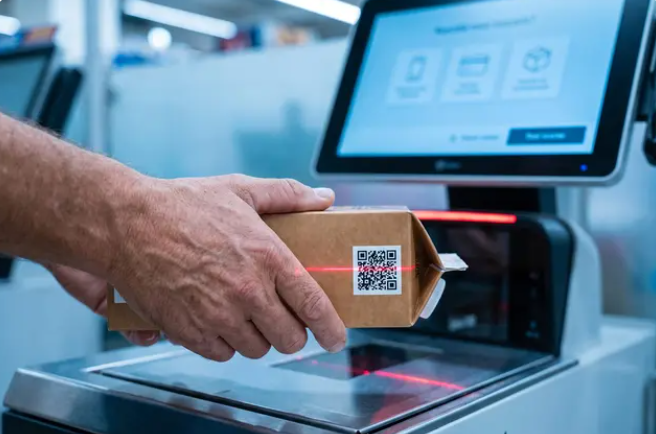
The total damage to Dutch retail caused by theft at self-checkout registers is estimated at 1 billion euros per year. Since the large-scale introduction of self-checkouts, shrinkage losses in the supermarket sector have doubled from 1% to an estimated 2% of total turnover. In response, Dutch inventor John Barzilaij has developed a patented solution that tackles the problem at its source. His innovative dual product authentication method combines a QR code with an RFID tag, allowing products to be automatically identified and verified during checkout. Not after the fact through random checks or camera surveillance, but directly during the payment process.

According to Barzilaij, current security measures fall short. Random checks, exit gates, cameras, and AI systems can detect fraud, but they do not prevent it. Furthermore, they frequently cause frustration for customers and raise privacy concerns. His technology therefore takes a different approach: prevention instead of retroactive checking. Since the police are also increasingly withdrawing from the civil handling of shoplifting, this proactive approach also offers a suitable solution to the increasingly pressing enforcement problem.
Preventing shoplifting instead of checking after the fact works as follows. As soon as a customer logs into the self-checkout, an RFID scanner reads all products in the shopping basket or cart at once and generates a shopping list from this. Next, the customer scans the QR codes of the products as usual. A specially developed Cyber-Physical System simultaneously compares these QR codes with the RFID list. If a product is missing or something has not been scanned correctly, the customer receives instructions via the screen on how to correct this. Only after correction can the payment be finalized, the groceries packed, and the store left.
"The fundamental difference is that you prevent shoplifting instead of trying to detect it after the fact," says Barzilaij. "The dual product authentication method checks in advance whether all products have actually been paid for. This makes random checks and other customer-unfriendly controls largely redundant."
Alignment with global retail developments
The innovation aligns with a major development within retail. In the coming years, the sector will transition globally to the new GS1 Digital Link QR code (Sunrise 2027). Combined with the further introduction and development of RFID technology, Barzilaij believes a significant POS efficiency gain can be made: halving the processing time per self-checkout register.
In sectors where RFID is already widely used, such as the fast-fashion industry, implementation could even be possible in the relatively short term. Since RFID tags are broadly applicable to most packaging in the food retail branch, he expects that, given the rapid developments in RFID technology, implementation there will become economically viable from 2028 onwards.
Originated from practice
Barzilaij did not develop the method out of commercial ambition, but out of wonder. While using self-checkouts, he noticed how easily products could go unpaid without being noticed. When he subsequently read about the scale of the losses due to shoplifting at self-checkouts, he decided to think about a structural solution.
Thanks to his background in chemistry and psychology, and his experience as an international research guidance manager at Unilever R&D, he was able to combine technological and practical insights into a new security concept.
Patent as a basis for collaboration
The Dutch patent NL4000008 ‘Method and system for self-checkout at a point of sale’ was published on September 4, 2026. For Barzilaij, obtaining the patent is not an endpoint, but rather the beginning. He has no ambition to become a supplier of checkout systems himself. His goal is to find a strategic buyer or licensing partner who can implement the technology globally.
"I don't see myself as an entrepreneur who is going to roll out this technology myself," says Barzilaij. "I want a party with international clout to pick up this innovation and make it available to retailers all over the world."
For more information: pos-2fa-intermediary.com