




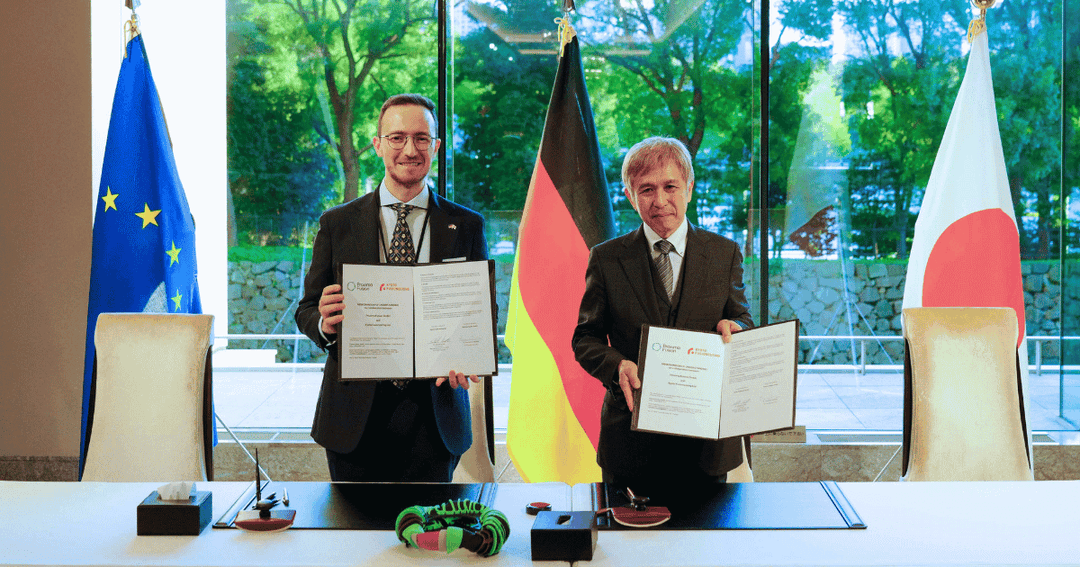
Signed in Tokyo during Chancellor Friedrich Merz's visit, the agreements with Fujikura and Kyoto Fusioneering target two of fusion's hardest bottlenecks: superconducting tape and plasma heating.
Image: Proxima Fusion CEO Francesco Sciortino (left) and a Kyoto Fusioneering representative at the MoU signing in Tokyo. Photo: Proxima Fusion (press image).
Munich-based Proxima Fusion, which describes itself as Europe's leading stellarator company, has signed two memoranda of understanding with Japanese industrial partners aimed at building the supply chain for commercial fusion power in Germany. The agreements were signed in Tokyo on 28 October during German Chancellor Friedrich Merz's visit to Japan.
A superconductor factory in Lower Saxony?
The first MoU, with Fujikura, a Japanese cable and electronics group founded in 1885 that is one of the leading makers of high-temperature superconductors (HTS), will assess whether to establish industrial-scale HTS tape production in Lower Saxony. As a first step the partners will evaluate the technical, commercial and economic case for a plant.
The numbers explain why. HTS tape is the material that makes compact, high-field stellarator magnets possible, and Proxima expects to need around 20,000 kilometres of it for its Alpha demonstrator and about 40,000 kilometres for each Stellaris power plant. Global production capacity is nowhere near the volumes a fusion industry would demand.
"A fusion power plant's supply chain has to be ready years before the plant itself," said Dr Francesco Sciortino, Proxima's co-founder and CEO. "This is how Europe builds its fusion supply chain: by connecting long-term demand with world-class manufacturing expertise."
Fujikura president and CEO Naoki Okada said fusion deployment "will require an industrial foundation capable of supplying high-performance HTS tape reliably and at scale", and that the company would apply its manufacturing know-how to assess a supply platform in Germany and across Europe.
Heating and fuelling the plasma
The second MoU expands Proxima's existing cooperation with Kyoto Fusioneering on next-generation gyrotrons, the high-power microwave sources used to heat plasma, and on fuel cycle technologies. Kyoto Fusioneering will also contribute to fusion deployment in Germany, including within the Fusion Hubs initiative of the Federal Ministry of Research, Technology and Space (BMFTR).
"The global race to fusion will be won in factories and supply chains," Sciortino said, adding that Japanese partners choosing Germany reflects strong backing for fusion from the German government and the EU. Kyoto Fusioneering president and COO Kiyoshi Seko said the cooperation would help "turn fusion into a real industry in Germany".
Why it matters
Berlin has set the goal of building the world's first fusion power plant in Germany, and Proxima, the first spin-out of the Max Planck Institute for Plasma Physics, is a central part of that bet. It plans Alpha, a net-energy demonstrator, for the early 2030s, followed by Stellaris later that decade.
The agreements are non-binding and no investment figures were disclosed, so a factory is not yet a given. But they shift the conversation from physics to industrial capacity, which is where many observers expect Europe's fusion ambitions to succeed or stall. Attracting a manufacturer like Fujikura to consider European production would also reduce dependence on a small number of overseas HTS suppliers.
Sources: Proxima Fusion press releases "Proxima Fusion and Fujikura Join Forces to Advance Industrial-Scale HTS Manufacturing in Germany" and "Proxima Fusion and Kyoto Fusioneering Join Forces to Build Critical Technologies for Commercial Fusion Power" (proximafusion.com, 28 October 2026); Kyoto Fusioneering news release (kyotofusioneering.com, 28 October 2026); Tech.eu and NucNet, 28 October 2026. No embargo applied.