




Erlangen's Quint raises €9.1m on a claim that it can make quantum error correction 100 times cheaper
03/11/2026
87
Quint Computing

Quint Computing, a ten-person spin-out from the University of Erlangen-Nuremberg, has raised €9.1 million on a bold promise: a superconducting quantum chip that would cut the hardware needed for error correction by a factor of 100. If it works, the biggest cost in building a useful quantum computer falls sharply. If not, investors led by Munich's Vsquared Ventures will have paid for one of the most expensive experiments in German deep tech.

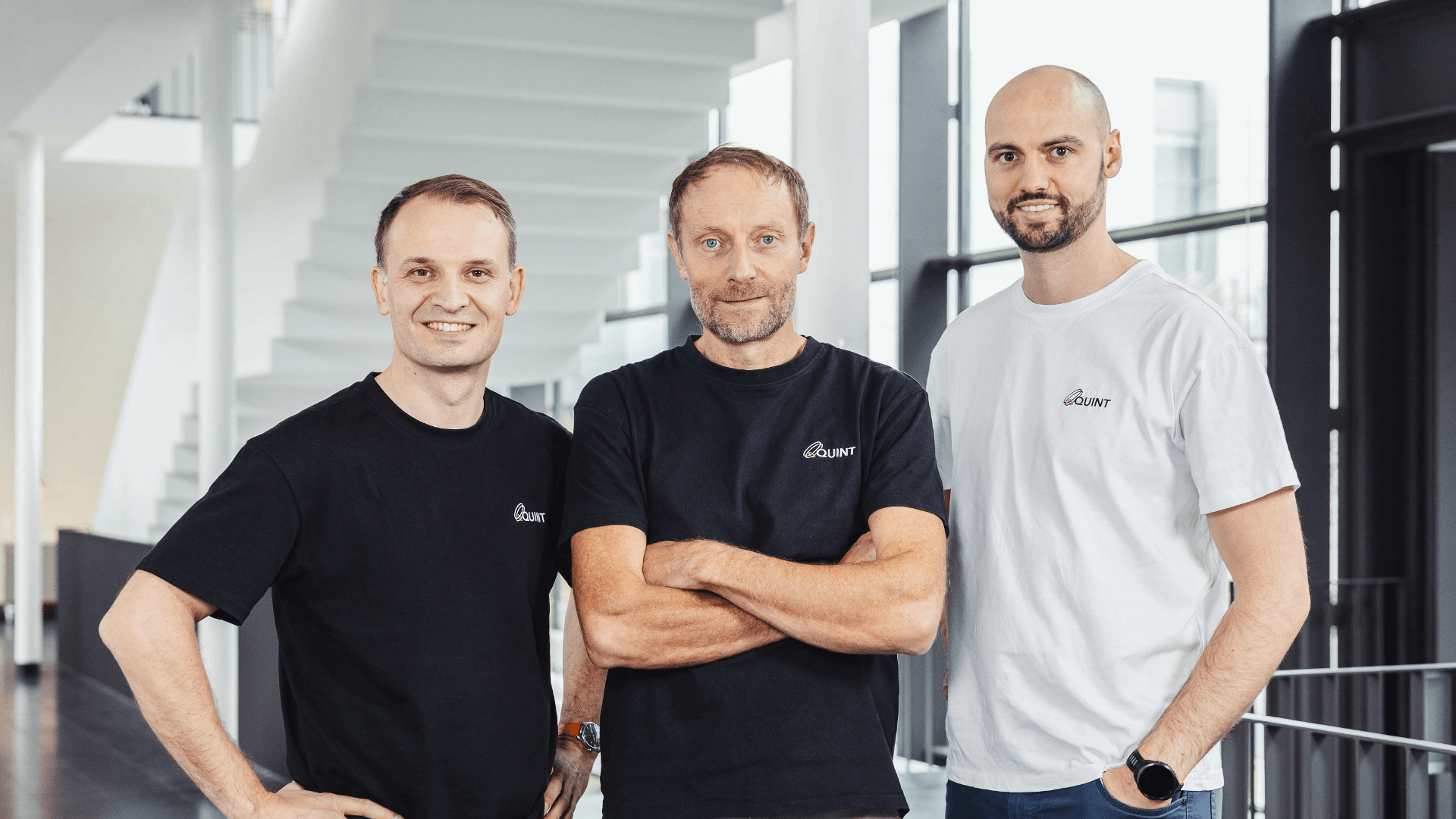
Image: Quint Computing. Credit: Quint Computing, via Tech.eu.

The seed round, announced on 3 November, was led by Vsquared with Paris-based quantum specialist Quantonation, Nucleus Capital, Faber, Vanagon Ventures and ZOHO.VC. Mikko Möttönen, co-founder of Finnish quantum companies IQM and QMill, invested personally. On top of the equity, the European Innovation Council has awarded Quint a €2.2 million Pathfinder grant, so roughly one euro in five of the company's new money comes from the EU budget.

Handelsblatt reported that no other German quantum company has raised as much at such an early stage. Quint was founded only in October 2025, by physicists Christopher Eichler (chief executive) and Michael Hartmann, who previously worked with Google's quantum team, together with economist Jona Stinner. "This has long stopped being basic research," Hartmann told the newspaper (translated from German).

The million-qubit problem

The company is attacking the central bottleneck in the field. Qubits are fragile, and today's machines make too many errors to run commercially valuable calculations. The standard fix is to bundle many physical qubits into one reliable "logical" qubit, which multiplies hardware, wiring, cooling and energy costs. Eichler told Tech Funding News that Google's Willow chip has 105 physical qubits, while a commercially useful machine built the conventional way would need about a million.

Quint says its patented architecture builds error suppression into the chip itself, with a hierarchy of error probabilities that allows more efficient correction codes. According to the company, once fully implemented this could reduce system complexity, hardware requirements and energy use by a factor of 100 without slowing the processor. That figure is a design target, not a measured result: Quint has not published a demonstration, and its own roadmap puts proof of "record-high" error-correction efficiency "in the coming years".

Why it matters for Europe

Europe has strong quantum science but few companies with the money to compete with Google, IBM and well-funded US start-ups on superconducting hardware. Germany's answer has been regional clusters such as Munich Quantum Valley, of which Quint is part, plus a growing pile of public grants. A seed round of €9.1 million is small next to the hundreds of millions raised by IQM or US rivals, so Quint's bet is that a smarter architecture beats sheer scale.

"Our unique processor architecture reduces complexity while maintaining high clock speed," Eichler said in the company's statement, claiming "lower operational costs and a shorter path to commercialisation". Its first customers are likely to be universities: the company says it has an ongoing project to deploy processors there.

What happens next

Quint plans to grow from ten staff to about 25 by the end of 2027 and to 40-50 within two years, hiring in chip design, fabrication and error correction. The next test is technical rather than financial: showing on real hardware that the 100x claim holds. Until then, the round is a vote of confidence in a physics idea, and in its founders, rather than in a product.

Sources

  • Tech.eu, "Quint Computing raises €9.1M to scale quantum computing technology", 3 November 2026
  • Tech Funding News, "Quint Computing raises €9.1M to cut quantum error-correction overhead 100x", 3 November 2026
  • Handelsblatt, "Rekordfinanzierung für deutsches Quanten-Start-up", 3 November 2026

Recent

Cybersecurity News Apps Worth Your Attention

Breaking Tech Europe: Top 5 – Anne Boden Builds a Bank for AI Agents, Whitehall Hands ElevenLabs a £10.8m Voice Deal, and AI Floods Brussels

Microsoft's day-long outage shut Dutch courts' email and Amsterdam's service desks, while Berlin's on-premise servers kept running

AI Meeting Assistants Are Changing Who Gets Heard

Erlangen's Quint raises €9.1m on a claim that it can make quantum error correction 100 times cheaper

03/11/2026
87
Quint Computing

Quint Computing, a ten-person spin-out from the University of Erlangen-Nuremberg, has raised €9.1 million on a bold promise: a superconducting quantum chip that would cut the hardware needed for error correction by a factor of 100. If it works, the biggest cost in building a useful quantum computer falls sharply. If not, investors led by Munich's Vsquared Ventures will have paid for one of the most expensive experiments in German deep tech.

Image: Quint Computing. Credit: Quint Computing, via Tech.eu.

The seed round, announced on 3 November, was led by Vsquared with Paris-based quantum specialist Quantonation, Nucleus Capital, Faber, Vanagon Ventures and ZOHO.VC. Mikko Möttönen, co-founder of Finnish quantum companies IQM and QMill, invested personally. On top of the equity, the European Innovation Council has awarded Quint a €2.2 million Pathfinder grant, so roughly one euro in five of the company's new money comes from the EU budget.

Handelsblatt reported that no other German quantum company has raised as much at such an early stage. Quint was founded only in October 2025, by physicists Christopher Eichler (chief executive) and Michael Hartmann, who previously worked with Google's quantum team, together with economist Jona Stinner. "This has long stopped being basic research," Hartmann told the newspaper (translated from German).

The million-qubit problem

The company is attacking the central bottleneck in the field. Qubits are fragile, and today's machines make too many errors to run commercially valuable calculations. The standard fix is to bundle many physical qubits into one reliable "logical" qubit, which multiplies hardware, wiring, cooling and energy costs. Eichler told Tech Funding News that Google's Willow chip has 105 physical qubits, while a commercially useful machine built the conventional way would need about a million.

Quint says its patented architecture builds error suppression into the chip itself, with a hierarchy of error probabilities that allows more efficient correction codes. According to the company, once fully implemented this could reduce system complexity, hardware requirements and energy use by a factor of 100 without slowing the processor. That figure is a design target, not a measured result: Quint has not published a demonstration, and its own roadmap puts proof of "record-high" error-correction efficiency "in the coming years".

Why it matters for Europe

Europe has strong quantum science but few companies with the money to compete with Google, IBM and well-funded US start-ups on superconducting hardware. Germany's answer has been regional clusters such as Munich Quantum Valley, of which Quint is part, plus a growing pile of public grants. A seed round of €9.1 million is small next to the hundreds of millions raised by IQM or US rivals, so Quint's bet is that a smarter architecture beats sheer scale.

"Our unique processor architecture reduces complexity while maintaining high clock speed," Eichler said in the company's statement, claiming "lower operational costs and a shorter path to commercialisation". Its first customers are likely to be universities: the company says it has an ongoing project to deploy processors there.

What happens next

Quint plans to grow from ten staff to about 25 by the end of 2027 and to 40-50 within two years, hiring in chip design, fabrication and error correction. The next test is technical rather than financial: showing on real hardware that the 100x claim holds. Until then, the round is a vote of confidence in a physics idea, and in its founders, rather than in a product.

Sources

  • Tech.eu, "Quint Computing raises €9.1M to scale quantum computing technology", 3 November 2026
  • Tech Funding News, "Quint Computing raises €9.1M to cut quantum error-correction overhead 100x", 3 November 2026
  • Handelsblatt, "Rekordfinanzierung für deutsches Quanten-Start-up", 3 November 2026

Recent

© European Tech On Heels - 2026
Made with
Web Wings