



Binance to shut accounts in France, Italy, Spain and Poland on 31 December, with fees on leftover crypto from 29 November
More than four months after the EU's MiCA transition period ended, the world's largest crypto exchange still holds no licence anywhere in the bloc. Customers of its former local entities now have weeks to move their assets before a minimum 10 USDC charge starts eating small balances.
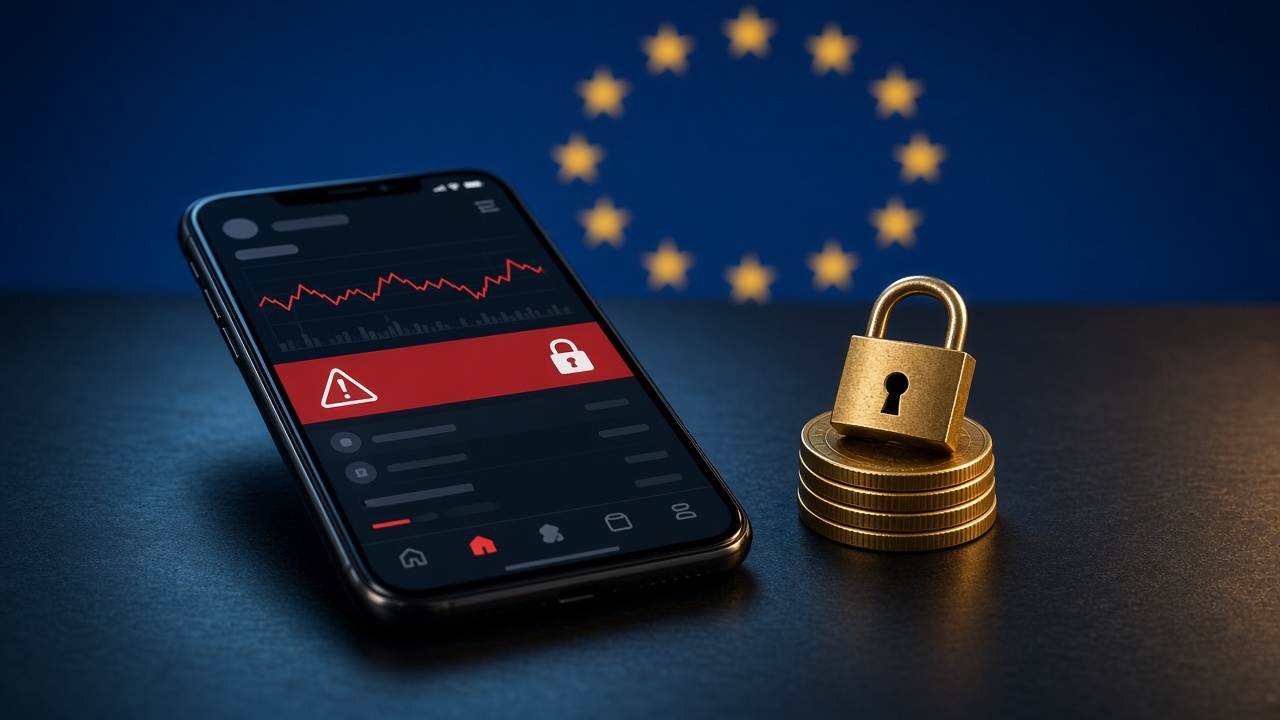
Illustration: AI-generated
Binance is closing customer accounts in four European Union countries where it once ran locally registered businesses, in the clearest sign yet that the exchange has run out of road under the EU's Markets in Crypto-Assets regulation (MiCA).
Emails sent to customers on 6 November, reported first by French and Polish crypto media and confirmed by a Binance spokesperson to CoinDesk, say that affected accounts "will be closed with effect from 31 December 2026". Users in France, Italy, Spain and Poland have reported receiving the notices. Deposits and trading are already switched off; withdrawals of crypto and euros still work.
The sting is in the interim. From 29 November, Binance will charge 0.025% of any remaining crypto balance per month, or 10 USDC, whichever is higher. A first deduction is taken within three days of 29 November and a second after 24 December. Polish outlet Bitcoin.pl, which received the email itself, worked through the arithmetic: the percentage only exceeds the 10 USDC floor on balances above 40,000 USDC. For a customer holding 1,000 USDC, the two charges amount to 2% of the account. Balances below 10 USDC are taken in full.
According to the email quoted by Cointelegraph France, crypto still on the platform after 31 December may be treated as belonging to an inactive account, which "may result in the conversion, transfer or any other processing of your crypto-assets" (translated).
A licence that never came
The four countries are where Binance operated national entities before MiCA's transitional regime expired at the end of June. France's market regulator, the AMF, lists the registration Binance France had held since May 2022 as having lapsed automatically on 2 July, the day more than 50 unlicensed providers were removed from the French register, CoinDesk reports. In June, Binance withdrew its MiCA application in Greece and said it would apply in another member state, which it has not named. It does not appear in the register of authorised crypto-asset service providers kept by the European Securities and Markets Authority.
Binance's public messaging has not changed since then. "Our commitment to Europe remains unchanged, and we are actively progressing our authorization pathway," a spokesperson told CoinDesk, calling the shutdown "a carefully managed process" with "no sudden freeze". The company said in June that it was "confident" of securing a licence "in the coming months". Five months on, that has not happened.
Gaps in the picture
Important details remain unconfirmed. Binance has not published a list of affected countries. Spanish outlet Criptoperiódico notes that the fee schedule is documented in the French and Polish emails but has not been confirmed for Binance Spain, whose terms allow a dormant-account charge without fixing an amount. Customers in EU countries where Binance had no local entity, such as Portugal, have not been singled out in the same way, according to Portuguese newspaper Expresso, cited by CoinDesk. Binance has also not said how many European customers are affected; Cointelegraph cites press reports that its app was downloaded more than four million times in the EU last year.
Italian consumer association ADUC has published the deadlines for Italian users. Spanish and Polish outlets also warn customers to check that any notice really comes from Binance, as phishing tends to follow announcements like this.
Why it matters
For the EU, the case is MiCA's most visible test so far: the regime's single "passport" was meant to give licensed firms access to all 27 markets, and that also means an unlicensed giant cannot keep serving customers through old national registrations. For competitors already holding MiCA licences, the coming weeks offer a pool of customers who must move their assets somewhere. For Binance, every week without authorisation increases the cost of coming back.
The next dates to watch are 29 November, when the first fee is calculated, and 31 December, when the accounts close.
Sources
- CoinDesk: Binance users in some European countries told to pull crypto before fees kick in (7 Nov 2026)
- Bitcoin.pl (Polish): Binance Poland zamknie konta 31 grudnia (7 Nov 2026)
- Cointelegraph France (French): Binance France annonce la fermeture des comptes de ses utilisateurs le 31 décembre
- Le Figaro (French): Clap de fin pour Binance France (8 Nov 2026)
- ADUC (Italian): Binance chiude in Francia, Spagna, Italia e Polonia (8 Nov 2026)
- Criptoperiódico (Spanish): Binance confirma cierres el 31 de diciembre; comisión en España dudosa (9 Nov 2026)