


Brussels confirms EU Academy data leak as a month-old cyberattack, suspected to be China-linked, is still not contained
The European Commission says names and email addresses of external EU Academy users leaked in a cyber campaign first detected on 22 October. Two sources tell Euronews that investigators suspect a China-backed group. Brussels will not say whether the attack is over, and staff have been told to expect more outages.
The European Commission has admitted that people outside the institution have had personal data stolen in a cyberattack that has been running through its IT systems for a month. It cannot yet say how many are affected or whether the intruder has been expelled.
"We can confirm that the EU Academy platform has been affected by the detected cyber campaign against the Commission," spokesperson Thomas Regnier told reporters at Monday's midday briefing, as reported by POLITICO Europe. "This resulted in a leak of personal data of EU Academy users." An EU official told POLITICO that names and email addresses were taken and added: "It's not over yet."
The EU Academy offers online courses on EU policy to outside users, and only external users are affected, according to Agence Europe, which reported in French that the platform was disabled from 11 November and will stay offline until 14 January. Euronews gave a different timeline, saying the site was taken down on Saturday.
Why it is breaking news
Monday's confirmation is the first time Brussels has acknowledged that data was actually stolen. It also came with the first account of who may be behind the attack. Citing two sources, Euronews reported that the Commission suspects a China-backed network of threat actors, nicknamed "Panda" internally. The suspicion rests on how sophisticated the attack was and on its use of ARTEX, a Chinese-developed tool that uses AI to find software vulnerabilities. Officially, Brussels is not blaming anyone. "For now, no attribution from our side," Regnier said. Beijing has consistently denied sponsoring hacking groups.
Regnier declined to say whether the breach was contained. In an internal note seen by POLITICO, Executive Vice-President Henna Virkkunen and Budget Commissioner Piotr Serafin warned staff of "further temporary interruptions" and wrote: "When attackers operate at machine speed, we cannot respond at human speed."
A month inside the network
The Commission's IT department detected the intruder on 22 October, according to Euronews. The attack only became public on 19 November, when POLITICO reported it. For several days staff could not use Sysper, the HR system for salaries, leave and timesheets. Some internal apps remain offline. The Commission says it has no evidence of a breach affecting staff data as a whole.
The Commission's handling of the incident deserves some scepticism. Cristiano Sebastiani, chair of the Renouveau & Démocratie union, called the lack of internal communication "unacceptable" and asked for an independent review, POLITICO reported. EU Academy users have not been emailed individually. Instead, a general notice on the website warns them about phishing. Rapporteur noted that EU data protection law requires the Commission, as data controller, to inform people whose data has been breached. The Commission says the notice is clear and transparent. The European Data Protection Supervisor has been informed.
It is also the Commission's third known incident this year, after an attack on its mobile-device infrastructure in January and a breach of the cloud hosting the Europa.eu websites in which about 91.7 GB of data was stolen, Euronews reported.
What happens next
The Commission says it will name the attackers only once its investigation is complete. The next things to watch are whether staff HR data turns out to be compromised, how many EU Academy users are affected and whether the EDPS acts. The institution that writes Europe's cybersecurity rules for companies now has to show it can follow them itself.
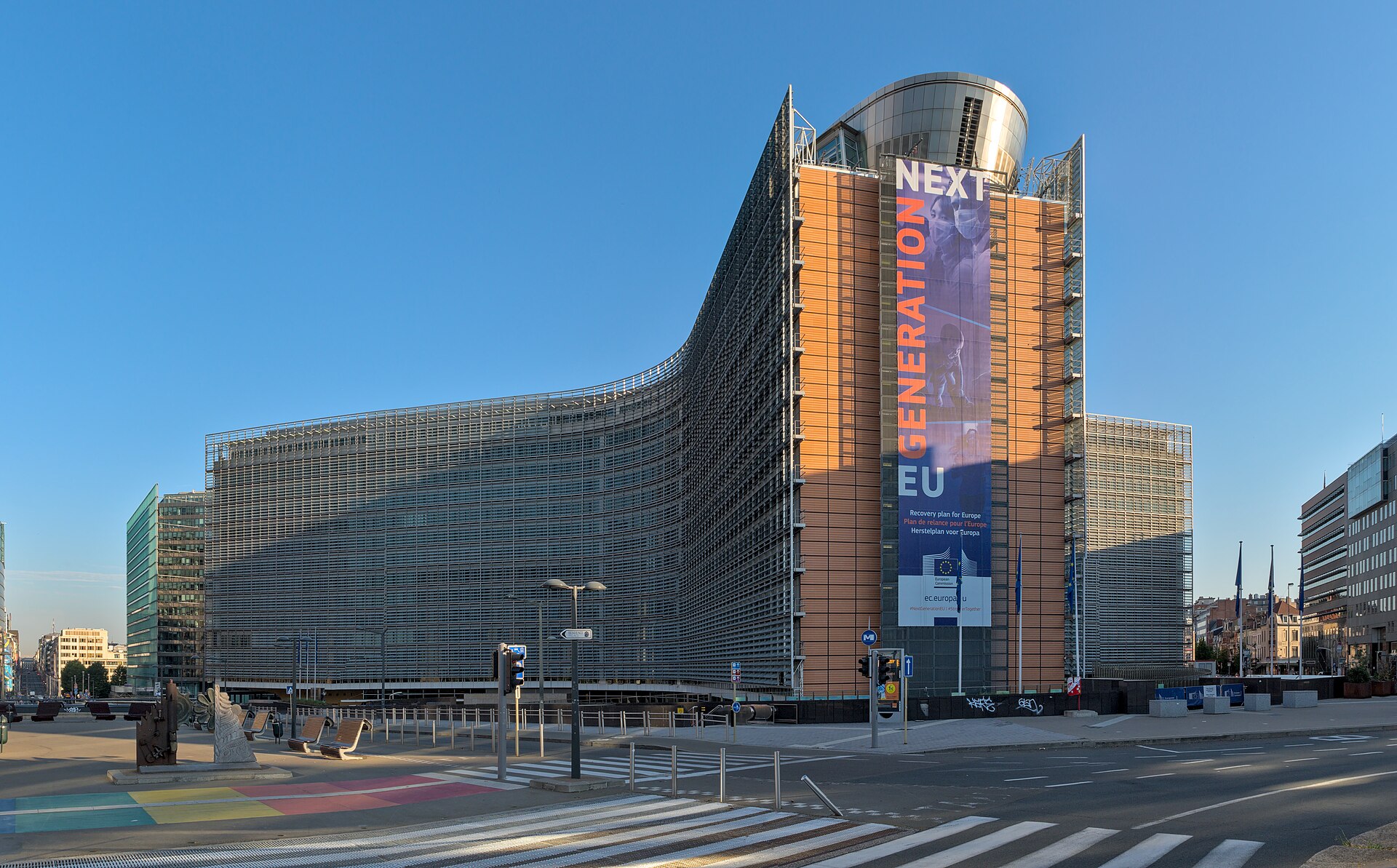
Photo: Trougnouf (Benoit Brummer) via Wikimedia Commons, CC BY 4.0. The Berlaymont building, European Commission headquarters, Brussels.
Sources
- POLITICO Europe, "EU Commission confirms personal data leak after cyberattack, warns of further disruption", 23 Nov 2026: https://www.politico.eu/article/european-commission-personal-data-leak-cyberattack-disruption/
- Euronews, "Exclusive: China-backed hackers suspected behind ongoing EU Commission cyberattack", 23 Nov 2026: https://www.euronews.com/2026/11/23/exclusive-china-backed-hackers-suspected-behind-ongoing-eu-commission-cyberattack
- Agence Europe (French), 23 Nov 2026: https://agenceurope.eu/fr/bulletin/article/13988/28/cyberattaque-la-commission-europeenne-confirme-des-fuites-de-donnees-sur-la-plateforme-eu-academy
- Rapporteur (French), 23 Nov 2026: https://www.rapporteur.com/fr/news/des-utilisateurs-externes-du-site-web-de-lue-touches-par-la-cyberattaque-contre-la-commission/
- POLITICO Europe, "'Staff deserve answers' on Commission cyberattack, union says", 20 Nov 2026: https://www.politico.eu/article/staff-deserve-answers-eu-commission-cyberattack-union-says/
- Euronews, "European Commission staff criticise lack of communication over cyberattack", 20 Nov 2026: https://www.euronews.com/2026/11/20/european-commission-staff-criticise-lack-of-communication-over-cyberattack