



Digital Science acquires Jenni AI to ground AI-assisted academic writing in 171 million research papers
31/10/2026
3
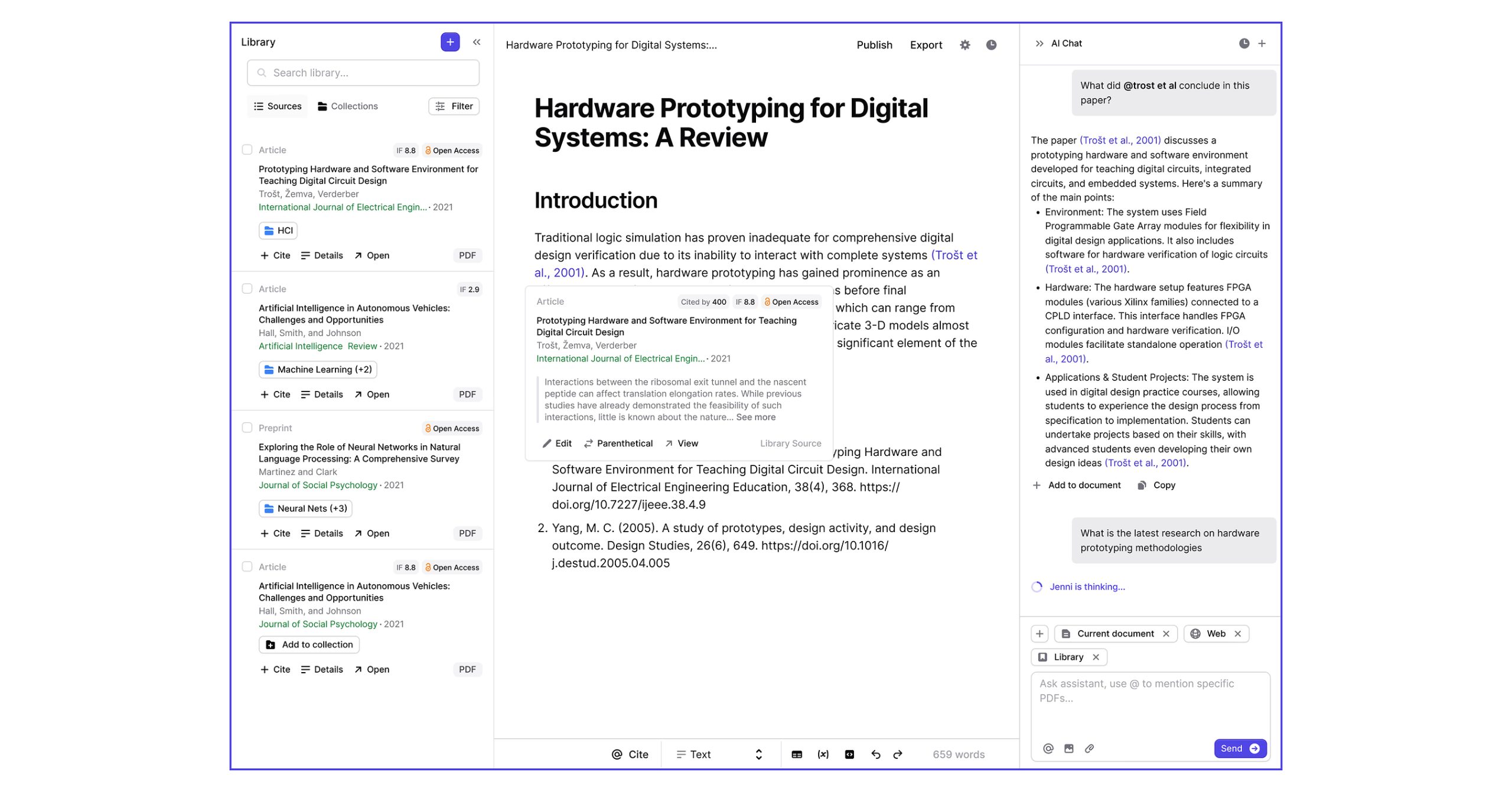
Jenni AI research and writing interface showing a library of sources, a draft review paper and an AI chat panel

The London research-technology group will connect Jenni AI, used by more than 8 million students and researchers, to its Dimensions database of 171 million publications so that suggested sources can be checked against the published record.

Jenni AI's research and writing interface. Image: Digital Science / Jenni AI, via PR Newswire.

Digital Science, the London-based company behind research tools including Dimensions, Overleaf and Altmetric, has acquired Jenni AI, an AI research and writing assistant for academic work. The deal was announced on 29 October. Financial terms were not disclosed.

Jenni AI says more than 8 million students and researchers in 189 countries use its platform. Users can upload papers or import reference libraries, work through their sources, draft and edit text, and check citations against the original material. The company was founded in 2020 by David Park and Henry Mao.

Citations checked against 171 million papers

Over the coming months, Digital Science plans to connect Jenni AI to its research data, starting with Dimensions, its database of 171 million research publications, and its full-text search. The aim is for the sources that Jenni AI users find and cite to be grounded in the published research record. In its announcement, Digital Science pointed out that general-purpose AI tools can generate references that do not exist.

"Researchers already use AI as a matter of routine. What they can't get from a general-purpose tool is a citation that has been checked against the actual paper," said Stephen Leicht, chief executive of Digital Science. "Inside Digital Science, every source it suggests can be verified against Dimensions and its 171 million publications, and that stays true as their work grows from a first thesis chapter to a funded lab."

David Park, chief executive of Jenni AI, said: "We started Jenni with the belief that the future is written with AI, not by AI." Joining Digital Science, he added, was "a major step toward a future where every researcher has access to the knowledge, tools, and confidence to push the boundaries of human discovery".

Jenni AI will continue as a standalone product under its own name, with the same team, pricing and subscription plans. It joins Overleaf, the collaborative LaTeX writing platform, the reference manager ReadCube and the Papers AI tool in Digital Science's portfolio of research tools. The company says the deal also strengthens its direct relationships with PhD and master's students at the start of their careers.

Digital Science cited a September 2026 Oxford University Press survey of more than 2,600 researchers. It found that 74% are unsure which uses of AI they should disclose, and 48% say they have not fully disclosed their use.

Why it matters

Generative AI has moved quickly into academic writing, and universities, publishers and funders across Europe are still working out the rules on disclosure and research integrity. Fabricated or misattributed references are one of the most visible failure modes. The deal puts an AI-native writing tool with millions of users inside one of the bigger owners of scholarly metadata, and makes verifiable citations the selling point rather than raw text generation. It also extends a UK research-infrastructure company's reach from institutions and publishers to individual students, a group that already relies heavily on general-purpose AI assistants.

Sources

  • Digital Science press release, "Digital Science acquires Jenni AI, connecting 8 million students and researchers to the published research record", London, 29 October 2026 (also via PR Newswire)
  • Tech.eu, 29 October 2026
  • Dealroom News, 29 October 2026 (terms not disclosed)

Recent

Imperial spin-out Machenta raises record $40M seed to teach robots tasks from a single demo

France's 2027 budget cuts La French Tech's state funding by 74%, as MPs vote to restore it

NexGen Cloud secures $106M GPU-backed loan to add 1,728 Nvidia GPUs in Finland

Madrid's Talky raises €1.5M to teach AI the unwritten rules of corporate accounting

Digital Science acquires Jenni AI to ground AI-assisted academic writing in 171 million research papers

31/10/2026
3
Jenni AI research and writing interface showing a library of sources, a draft review paper and an AI chat panel

The London research-technology group will connect Jenni AI, used by more than 8 million students and researchers, to its Dimensions database of 171 million publications so that suggested sources can be checked against the published record.

Jenni AI's research and writing interface. Image: Digital Science / Jenni AI, via PR Newswire.

Digital Science, the London-based company behind research tools including Dimensions, Overleaf and Altmetric, has acquired Jenni AI, an AI research and writing assistant for academic work. The deal was announced on 29 October. Financial terms were not disclosed.

Jenni AI says more than 8 million students and researchers in 189 countries use its platform. Users can upload papers or import reference libraries, work through their sources, draft and edit text, and check citations against the original material. The company was founded in 2020 by David Park and Henry Mao.

Citations checked against 171 million papers

Over the coming months, Digital Science plans to connect Jenni AI to its research data, starting with Dimensions, its database of 171 million research publications, and its full-text search. The aim is for the sources that Jenni AI users find and cite to be grounded in the published research record. In its announcement, Digital Science pointed out that general-purpose AI tools can generate references that do not exist.

"Researchers already use AI as a matter of routine. What they can't get from a general-purpose tool is a citation that has been checked against the actual paper," said Stephen Leicht, chief executive of Digital Science. "Inside Digital Science, every source it suggests can be verified against Dimensions and its 171 million publications, and that stays true as their work grows from a first thesis chapter to a funded lab."

David Park, chief executive of Jenni AI, said: "We started Jenni with the belief that the future is written with AI, not by AI." Joining Digital Science, he added, was "a major step toward a future where every researcher has access to the knowledge, tools, and confidence to push the boundaries of human discovery".

Jenni AI will continue as a standalone product under its own name, with the same team, pricing and subscription plans. It joins Overleaf, the collaborative LaTeX writing platform, the reference manager ReadCube and the Papers AI tool in Digital Science's portfolio of research tools. The company says the deal also strengthens its direct relationships with PhD and master's students at the start of their careers.

Digital Science cited a September 2026 Oxford University Press survey of more than 2,600 researchers. It found that 74% are unsure which uses of AI they should disclose, and 48% say they have not fully disclosed their use.

Why it matters

Generative AI has moved quickly into academic writing, and universities, publishers and funders across Europe are still working out the rules on disclosure and research integrity. Fabricated or misattributed references are one of the most visible failure modes. The deal puts an AI-native writing tool with millions of users inside one of the bigger owners of scholarly metadata, and makes verifiable citations the selling point rather than raw text generation. It also extends a UK research-infrastructure company's reach from institutions and publishers to individual students, a group that already relies heavily on general-purpose AI assistants.

Sources

  • Digital Science press release, "Digital Science acquires Jenni AI, connecting 8 million students and researchers to the published research record", London, 29 October 2026 (also via PR Newswire)
  • Tech.eu, 29 October 2026
  • Dealroom News, 29 October 2026 (terms not disclosed)

Recent

© European Tech On Heels - 2026
Made with
Web Wings