


Imperial spin-out Machenta raises record $40M seed to teach robots tasks from a single demo

31/10/2026
2
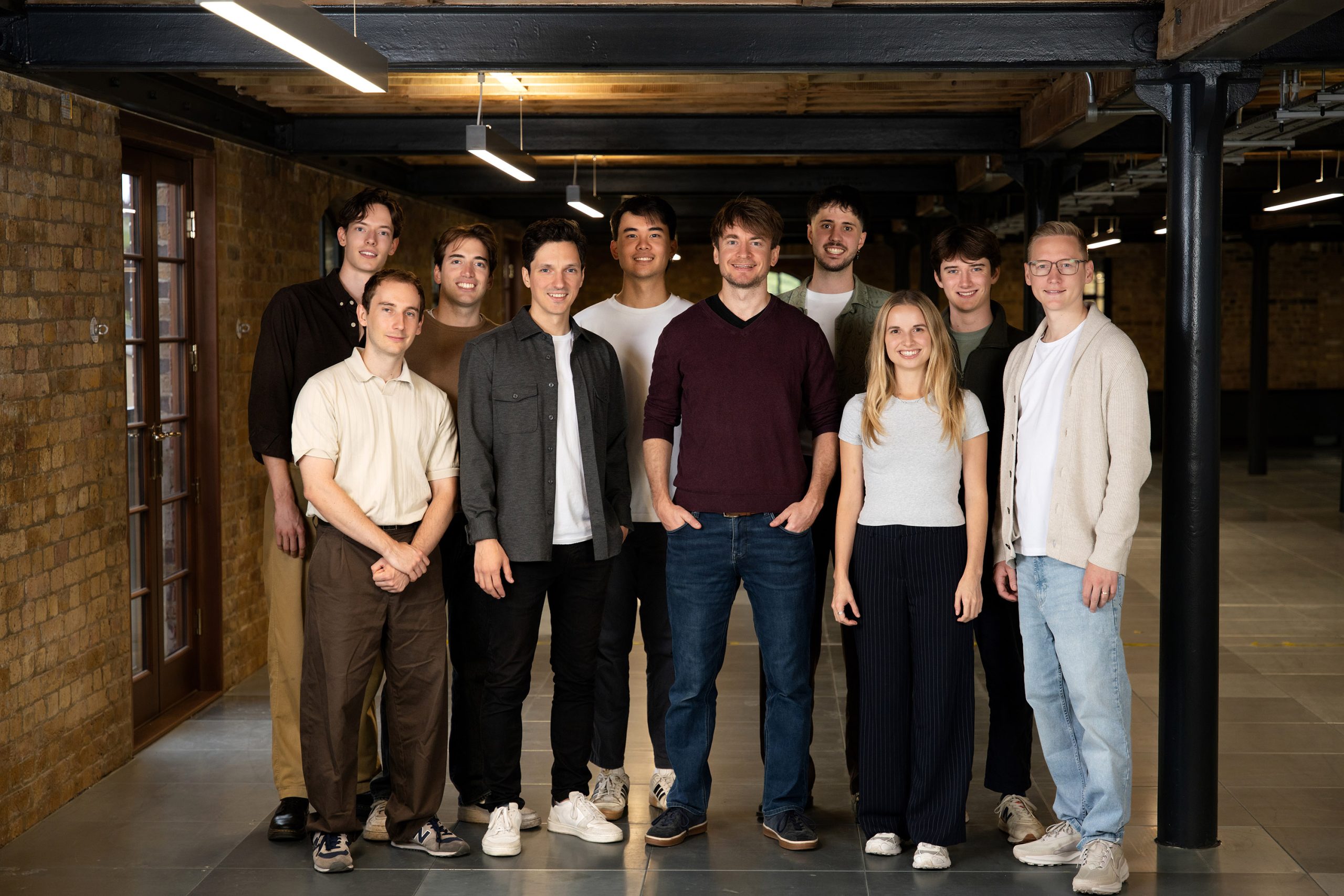
Professor Ed Johns, Vitalis Vosylius and members of the Machenta team

The Imperial College London spin-out says its robot foundation model, trained entirely in simulation, can pick up a new physical task after seeing it done once.

Image: Professor Ed Johns, Vitalis Vosylius and other members of the Machenta team. Photo: Oscar May / Imperial College London.

Machenta, a London robotics start-up spun out of Imperial College London, has raised $40 million in a seed round co-led by Swedish venture firm Creandum and New York-based Union Square Ventures (USV). Imperial says it is the largest seed round ever raised by a UK robotics start-up. The company came out of stealth with the announcement on 27 October and did not disclose its valuation, according to Business Insider.

The money will go towards scaling Machenta's AI model and growing its team, which numbers around a dozen people, at a new office and lab in King's Cross, London.

One demonstration instead of days of training

Today's AI-powered robots typically learn a task from humans demonstrating it many times, a process that can take days. Adding a new skill usually means another round of model updates by developers. Machenta says its model lets a robot learn a new task, such as packing, assembling or tidying, from a single demonstration, and that the same model works across different robots, including humanoids.

The company also takes an unusual route on training data. While many developers of robot foundation models are racing to collect large volumes of real-world footage and human demonstrations, Machenta pre-trains its model entirely on computer-generated environments. Imperial notes that this could free future developers from the practical and privacy constraints of gathering human data at scale. Johns has described the approach as "physical vibe coding", Tech.eu reports.

"Intelligence is not so much about what you can already do, it's about how quickly you can learn to do something new," said Professor Edward Johns, co-founder and CEO of Machenta and Professor of Robot Learning at Imperial's Department of Computing. "Humans don't need to see the same thing over and over before they can do it. [...] We've spent years trying to understand what it would take for robots to learn at the speed of a human. That is what instant robot learning is about."

Six years of lab research

The work began six years ago at Imperial's Robot Learning Lab, which Johns directs. Once the lab's techniques showed promise, Johns and his PhD student Vitalis Vosylius founded Machenta with colleagues from the lab. USV notes that Johns has also led robot learning work at Dyson.

"Very few teams in robotics can point to a body of work like this, which has repeatedly changed what people thought was possible," said Kathi Wilhelm, partner at Creandum. "They're not starting with just a theory of how robots can learn like humans; they're building on years of experience actually making it happen."

Sifted reports that the investors backed the company before it had a commercial product, after a Creandum team visited its earlier office in Archway, London, in May to test the model with props of its own.

Why it matters

Physical AI has become one of the most heavily funded corners of the technology sector, and much of the capital so far has gone to large US players building models on huge real-world datasets. A record UK seed round for a university spin-out that is betting on simulation and fast learning gives Europe a distinct contender in that race. It also strengthens the case that European universities can turn deep research into venture-scale companies.

"Machenta's early success signals an opportunity for the UK to become a global leader in AI-enabled robotics, drawing on the specialist capabilities of universities like Imperial," said Professor Mary Ryan, Vice-Provost (Research and Enterprise) at Imperial College London.

Sources

  • Imperial College London news release, 27 October 2026
  • Tech.eu, 27 October 2026
  • Union Square Ventures, "Physical Vibe Coding: Our Investment in Machenta"
  • Business Insider, October 2026
  • Sifted, 30 October 2026

Recent

France's 2027 budget cuts La French Tech's state funding by 74%, as MPs vote to restore it

Digital Science acquires Jenni AI to ground AI-assisted academic writing in 171 million research papers

NexGen Cloud secures $106M GPU-backed loan to add 1,728 Nvidia GPUs in Finland

Madrid's Talky raises €1.5M to teach AI the unwritten rules of corporate accounting

Imperial spin-out Machenta raises record $40M seed to teach robots tasks from a single demo
31/10/2026
2
Professor Ed Johns, Vitalis Vosylius and members of the Machenta team

The Imperial College London spin-out says its robot foundation model, trained entirely in simulation, can pick up a new physical task after seeing it done once.

Image: Professor Ed Johns, Vitalis Vosylius and other members of the Machenta team. Photo: Oscar May / Imperial College London.

Machenta, a London robotics start-up spun out of Imperial College London, has raised $40 million in a seed round co-led by Swedish venture firm Creandum and New York-based Union Square Ventures (USV). Imperial says it is the largest seed round ever raised by a UK robotics start-up. The company came out of stealth with the announcement on 27 October and did not disclose its valuation, according to Business Insider.

The money will go towards scaling Machenta's AI model and growing its team, which numbers around a dozen people, at a new office and lab in King's Cross, London.

One demonstration instead of days of training

Today's AI-powered robots typically learn a task from humans demonstrating it many times, a process that can take days. Adding a new skill usually means another round of model updates by developers. Machenta says its model lets a robot learn a new task, such as packing, assembling or tidying, from a single demonstration, and that the same model works across different robots, including humanoids.

The company also takes an unusual route on training data. While many developers of robot foundation models are racing to collect large volumes of real-world footage and human demonstrations, Machenta pre-trains its model entirely on computer-generated environments. Imperial notes that this could free future developers from the practical and privacy constraints of gathering human data at scale. Johns has described the approach as "physical vibe coding", Tech.eu reports.

"Intelligence is not so much about what you can already do, it's about how quickly you can learn to do something new," said Professor Edward Johns, co-founder and CEO of Machenta and Professor of Robot Learning at Imperial's Department of Computing. "Humans don't need to see the same thing over and over before they can do it. [...] We've spent years trying to understand what it would take for robots to learn at the speed of a human. That is what instant robot learning is about."

Six years of lab research

The work began six years ago at Imperial's Robot Learning Lab, which Johns directs. Once the lab's techniques showed promise, Johns and his PhD student Vitalis Vosylius founded Machenta with colleagues from the lab. USV notes that Johns has also led robot learning work at Dyson.

"Very few teams in robotics can point to a body of work like this, which has repeatedly changed what people thought was possible," said Kathi Wilhelm, partner at Creandum. "They're not starting with just a theory of how robots can learn like humans; they're building on years of experience actually making it happen."

Sifted reports that the investors backed the company before it had a commercial product, after a Creandum team visited its earlier office in Archway, London, in May to test the model with props of its own.

Why it matters

Physical AI has become one of the most heavily funded corners of the technology sector, and much of the capital so far has gone to large US players building models on huge real-world datasets. A record UK seed round for a university spin-out that is betting on simulation and fast learning gives Europe a distinct contender in that race. It also strengthens the case that European universities can turn deep research into venture-scale companies.

"Machenta's early success signals an opportunity for the UK to become a global leader in AI-enabled robotics, drawing on the specialist capabilities of universities like Imperial," said Professor Mary Ryan, Vice-Provost (Research and Enterprise) at Imperial College London.

Sources

  • Imperial College London news release, 27 October 2026
  • Tech.eu, 27 October 2026
  • Union Square Ventures, "Physical Vibe Coding: Our Investment in Machenta"
  • Business Insider, October 2026
  • Sifted, 30 October 2026

Recent

© European Tech On Heels - 2026
Made with
Web Wings