


Dresden AI chipmaker Sparxity raises €33m Series A from Lockheed Martin, GlobalFoundries and the EIC Fund
The TU Dresden spin-off formerly called SpiNNcloud says total funding is now $90m. It wants its next-generation chip in Deutsche Telekom data centres in 2028. Its headline performance numbers are the company's own and have not been independently tested.
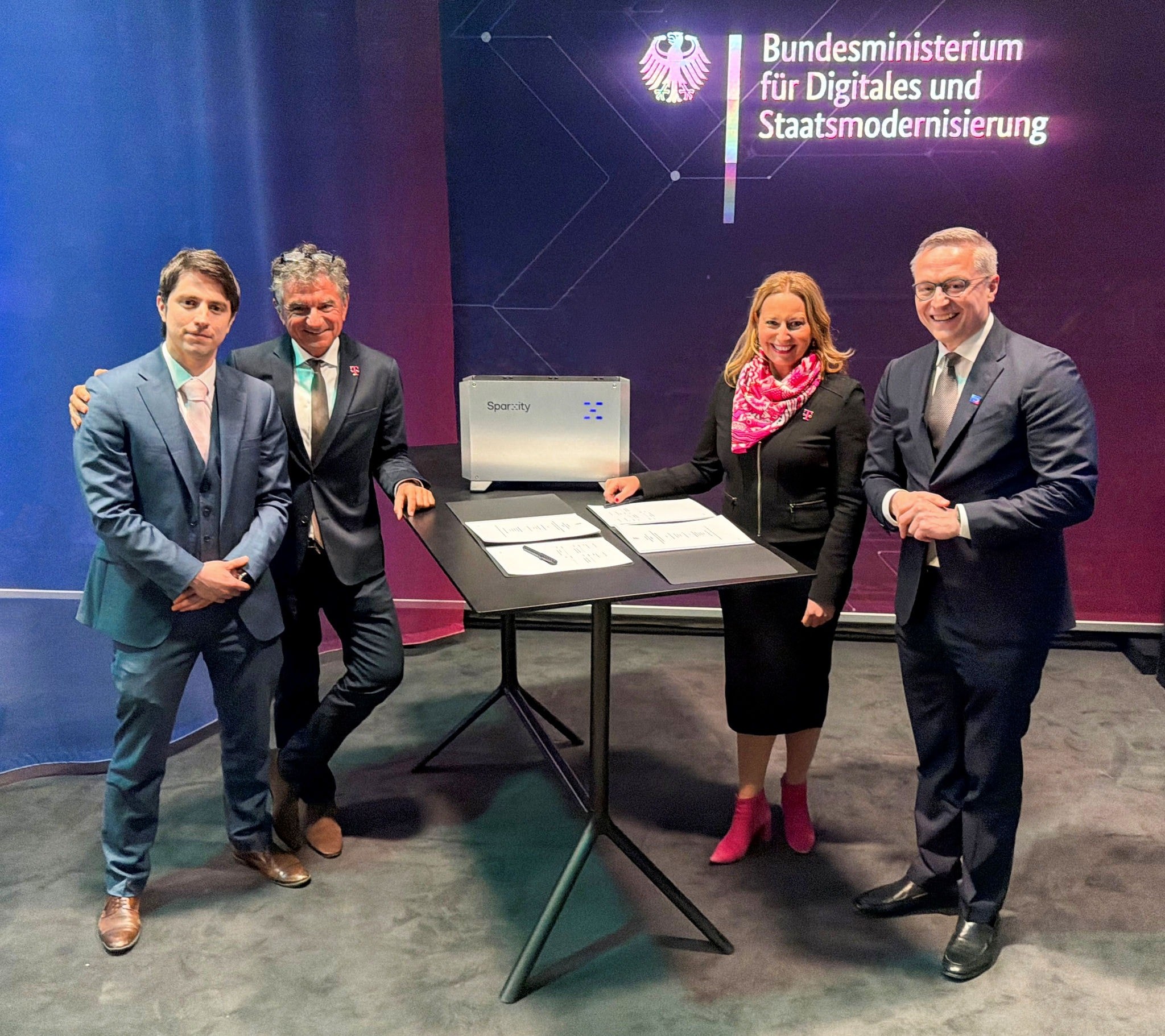
Photo: Deutsche Telekom AG/Rainer Knirsch (press image). From left: Sparxity CEO Hector A. Gonzalez, T-Systems CEO Ferri Abolhassan, T-Systems commercial director Elke Anderl and digital minister Karsten Wildberger at the letter-of-intent signing, 3 November 2026
Sparxity, a Dresden company that designs AI chips and computing systems, has closed a Series A round led by Singapore-managed ICM HPQC Fund. Lockheed Martin Ventures, the US chip foundry GlobalFoundries, GS Futures, Cloudberry Ventures, TGFS and the European Innovation Council's EIC Fund also invested. The company's own announcement, distributed via Business Wire on Tuesday, gives only one number: cumulative funding of $90m (about €80m, according to EU-Startups). It does not say how much the Series A itself raised.
Berlin investor Atlantic, an existing shareholder, puts the round at €33m in its portfolio note. The Next Web pointed out that the company had left the figure out. The angel investors are Richard Socher, founder of Recursive Superintelligence, and Nancy Xu, whose start-up Moonhub was bought by Salesforce.
From brain-inspired chip to "sparse" AI
Sparxity was founded in 2021 as SpiNNcloud, a spin-off from TU Dresden built on SpiNNaker2, a brain-inspired chip. It renamed itself last month to match a narrower pitch: hardware for "dynamic sparsity". Many large AI models activate only a small fraction of their network for any given request. Conventional GPUs still move and compute far more data than that. Sparxity's chips are designed to skip the parts that are not needed.
The company says its next-generation chip targets "up to 44× faster AI inference in ultra-sparse models." Its current systems, it says, deliver 10× faster sparse solvers and 18× lower energy use for event-based machine learning "on selected workloads". These are vendor claims on hand-picked tasks. None of the announcements cites an independent benchmark. The 44× figure is a design target for a chip that has not shipped yet.
The traction figures are more concrete. Sparxity says it has completed three tape-outs, produced more than 70,000 chips, installed 12 racks and signed more than 30 customers, including large supercomputing centres. It also says revenue quadrupled between 2024 and 2025, but gives no absolute numbers. In October it announced a "multi-million-dollar" deployment at the Jülich Supercomputing Centre, home of JUPITER, Europe's first exascale machine.
A Telekom deal with a 2028 date
The most commercially significant step came a week before the round. At the German government's Digital Summit on 3 November, T-Systems and Sparxity signed a letter of intent, in the presence of digital minister Karsten Wildberger. Under the plan, Sparxity's current hardware will first be used to work out how to integrate its next chip into Telekom data centres, with roll-out "planned for 2028", according to Deutsche Telekom's German-language release. The release also says the details of the cooperation "will be agreed in the coming months". For now this is a statement of intent, not a supply contract.
"The project shows that digital sovereignty is achievable in Germany when we combine our own technological expertise with powerful infrastructure and strong partners," Wildberger said (translated). T-Systems chief executive Ferri Abolhassan said he looked forward to "having Sparxity on board in our AI factory soon", a reference to Telekom's Munich AI facility.
Why it matters
Europe's AI-chip start-ups are raising larger rounds as governments push for "sovereign" computing. EU-Startups lists UK-based OLIX (€270.5m), Spain's Openchip (€115m) and Dutch EUCLYD (more than €200m) among this year's deals. Next to those, a €33m Series A is modest. The backers are what stand out: a US defence prime's venture arm, one of the world's largest contract chipmakers and the EU's own fund, all betting on a chip from Saxony.
What to watch: whether Sparxity's 44× claim holds up in independent tests, and whether the Telekom letter becomes a binding order before the 2028 launch date.
Sources
- Business Wire / Sparxity: Sparxity Closes Series A, Bringing Total Funding to $90M (10 Nov 2026)
- Atlantic: Sparxity raises €33M Series A (10 Nov 2026)
- The Next Web: Dresden AI chipmaker Sparxity closes Series A, taking funding to $90M (10 Nov 2026)
- EU-Startups: Dresden-based Sparxity raises €80 million for sparse-native AI computing (10 Nov 2026)
- Deutsche Telekom (German): T-Systems und Sparxity stärken Europas souveräne KI-Infrastruktur (3 Nov 2026)