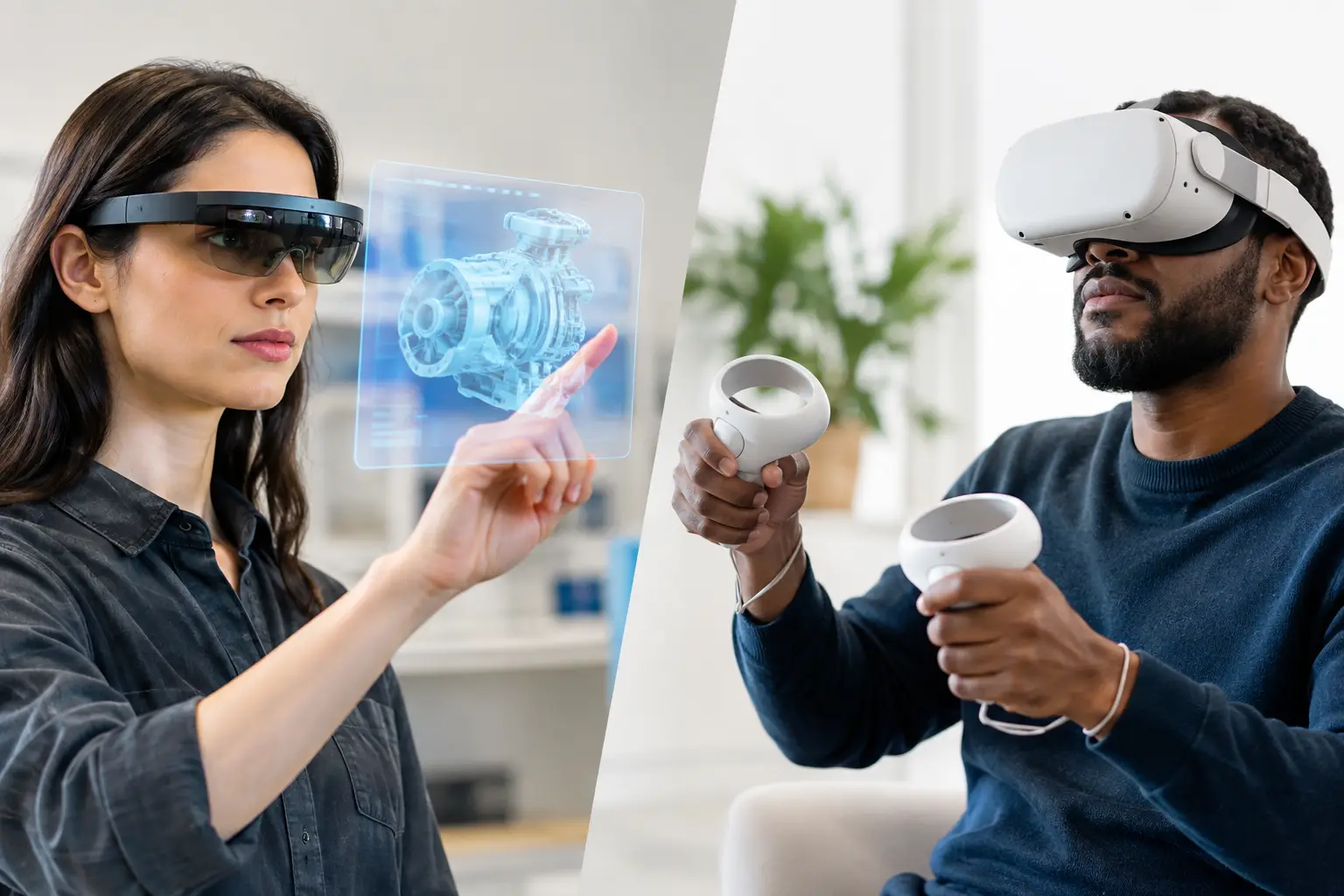
A field technician has both hands inside a wind turbine cabinet and needs the next step without looking away from the equipment. A new warehouse employee needs to practice a high-risk task repeatedly before stepping onto the floor. These are different learning problems, which is why the AR versus VR training decision should start with the work itself, not the headset.
For European companies investing in immersive learning, the stakes are practical. Skills gaps are widening in technical roles, safety standards are high, and employees expect development tools that respect their time. AR and VR can both improve training, but they create value in very different ways. Treating them as interchangeable can lead to an expensive pilot that never makes it into daily operations.
AR versus VR training: the core difference
Augmented reality, or AR, layers digital information onto the real environment. Through smart glasses, a tablet, or a phone, a learner might see step-by-step instructions, a highlighted component, or a remote expert’s annotation while working on actual equipment.
Virtual reality, or VR, places the learner in a computer-generated environment, typically through a headset. It can simulate a factory floor, a customer conversation, an operating room, or a cybersecurity incident without exposing anyone to the real-world consequences of getting it wrong.
That distinction matters because AR is usually strongest when the job and the learning happen at the same time. VR is strongest when people need a safe, focused place to rehearse before the job begins. One supports performance in context; the other creates a controlled space for practice.
When AR is the better training choice
AR earns its place when employees need guidance while completing real tasks. Think maintenance, installation, inspection, field service, logistics, and complex assembly. Instead of switching between a paper manual, a laptop, and the machine in front of them, workers can follow visual prompts in their line of sight.
For organizations with aging workforces or scarce technical expertise, AR can also capture institutional knowledge before it walks out the door. A senior engineer can help document procedures, record common errors, and support colleagues remotely. This is not simply a productivity story. It can make expertise more visible and transferable across locations, shifts, and career stages.
AR is particularly useful when equipment varies by site or when information changes often. Updating a digital workflow is generally easier than reprinting training manuals or bringing every employee back into a classroom. It may also reduce travel for specialists who can guide a colleague remotely, although remote support should not become a substitute for properly staffing teams.
There are limits. AR content must be accurate, clearly timed, and designed for the realities of the workplace. A cluttered interface is a distraction, especially around moving machinery or sensitive tasks. Organizations also need to assess device comfort, battery life, connectivity, data security, and whether protective equipment works with the chosen hardware.
When VR delivers more value
VR is built for scenarios where learning by doing is valuable, but doing it for real is risky, costly, rare, or emotionally difficult. It is well suited to safety drills, emergency response, equipment familiarization, customer-facing situations, leadership practice, and clinical training.
A VR simulation can let a trainee respond to a fire alarm, spot hazards on a construction site, or handle a tense performance conversation. Repetition is a major advantage. Learners can make mistakes, receive feedback, and try again without putting people, assets, or customer relationships at risk.
For employers, VR can offer a more consistent learning experience across countries and facilities. That is attractive for distributed European teams, where training quality can otherwise depend heavily on a local instructor’s availability. VR also produces useful interaction data, such as where learners hesitate or which decisions they repeatedly miss. Those signals can help improve the course, provided employers use them ethically and transparently.
Still, immersion is not the same as effectiveness. A visually impressive simulation with weak instructional design is just an expensive demo. VR requires thoughtful scenario writing, meaningful feedback, and assessments tied to the actual competencies employees need. Motion sickness, headset hygiene, physical space, and accessibility are also operational considerations, not afterthoughts.
Cost is more than the headset price
The hardware comparison can be misleading. Entry-level VR headsets may look affordable, while industrial AR glasses can carry a higher upfront price. But the real cost of immersive training includes content production, integration with learning systems, device management, updates, instructor support, and the time employees spend learning.
VR content often requires more upfront production because it builds a complete simulated environment. That investment can pay off when thousands of employees need the same high-value scenario, especially if real-world training would require shutting down equipment, traveling to a site, or using expensive materials.
AR programs can be more cost-effective when they focus on concise, repeatable workflows that change over time. A simple tablet-based AR experience may be enough for a pilot, particularly when a business case has not yet been proven. Smart glasses make sense when hands-free interaction is essential, not because they look more futuristic.
The best question is not, “Which technology is cheaper?” It is, “What is the cost of an untrained decision, a failed repair, a safety incident, or an unnecessary expert visit?” That moves the conversation from novelty to business impact.
Inclusion has to be designed in
Immersive training is often presented as universally engaging, but it can exclude people if teams make assumptions about bodies, access, language, or confidence with technology. This is especially relevant for organizations that want talent development to support a more representative tech workforce rather than reinforce existing gaps.
Headsets may not comfortably fit all hairstyles, eyewear, or personal protective equipment. Some employees may experience motion sensitivity, migraines, anxiety, or sensory overload. Others may not have equal access to a quiet location, reliable connectivity, or manager support to complete training. A VR exercise that relies on one cultural communication style can also distort how leadership potential or customer skills are assessed.
Build alternatives from the beginning. Provide a desktop or facilitated option where possible, caption audio, use clear language, test equipment with diverse users, and avoid collecting more behavioral data than the learning goal requires. Ask employees what helps them learn, rather than assuming the most immersive experience is the most equitable one.
There is also a representation question inside the content. Who appears as the expert, the engineer, the manager, or the person making decisions in a simulation? Training scenarios quietly shape ideas about who belongs in technical and leadership roles. Companies can use immersive learning to widen that picture, but only if diverse voices are involved in creating and reviewing it.
How to choose without getting stuck in pilot mode
Start with one high-value use case and define the result before selecting a platform. If the goal is reducing installation errors, track errors and time to competency. If the goal is improving confidence in difficult conversations, measure performance against a clear rubric, not just learner satisfaction.
Choose AR when people need digital support while interacting with the real world. Choose VR when they need realistic practice away from the real world. Use both only when the learning journey genuinely calls for it, such as VR for initial safety practice followed by AR prompts on the job.
Run a pilot with the people who will actually use it, including frontline workers, trainers, IT, security, and accessibility stakeholders. A technology decision made only by innovation teams can miss the conditions that determine adoption on a busy shift. Test not just whether learners enjoy the experience, but whether managers can deploy it, content owners can update it, and employees can use it without friction.
Finally, resist measuring success through completion rates alone. The strongest immersive training programs connect learning data to operational outcomes while protecting employee trust. That is where AR and VR move beyond a showcase for emerging tech and become part of a credible skills strategy.
The most useful immersive tool is rarely the one with the most spectacular demo. It is the one that gives more people the confidence, context, and opportunity to do meaningful work well.