


The European Investment Bank and Deutsche Bank say their new partnership will back €560 million of investment in satellites, launchers and space services, but neither has said how much of that is their own money.
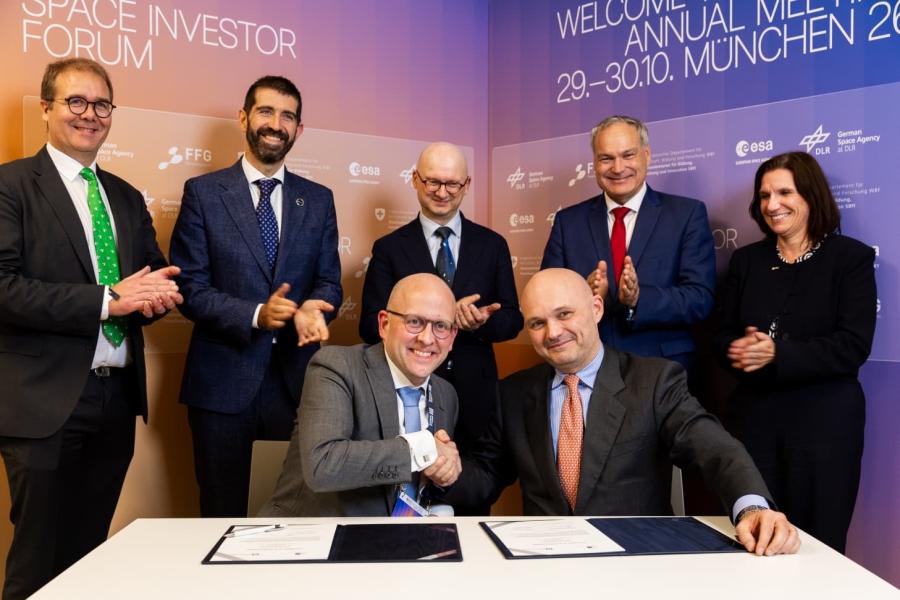
Image: European Investment Bank and Deutsche Bank representatives formally agree the space partnership, witnessed by Marcus Pleyer, State Secretary at the German Federal Ministry of Research, Technology and Space. Photo: EIB.
The European Investment Bank (EIB) and Deutsche Bank have agreed a partnership to back €560 million of new investment by European space companies, the two banks announced on 29 and 30 October. The deal was signed ahead of the European Space Agency's Space Investor Forum in Munich, where investors met space start-ups and scale-ups this week.
According to the announcement, around half of the investment is expected to go to Germany and the rest to other EU member states. The money is aimed at companies across the space supply chain, from component makers and launch developers to satellite applications and in-orbit services.
A loan problem, not a talent problem
The banks frame the deal as a fix for one of the sector's oldest bottlenecks: access to affordable, long-term debt. Space businesses often face long development cycles, complex technology and uncertain commercial returns, which makes conventional bank lending harder to secure, the release says. Under the partnership, Deutsche Bank gets long-term funding and "flexible financing structures" from the EIB to lend to "commercially viable" companies that are moving into their next stage of growth.
"Europe has the engineering talent to lead in space. Our job is to help finance its next stage of growth," said Marc Mueller, Global Head Trade Finance & Lending at Deutsche Bank. "Working with the EIB, we can offer space businesses the long-term financing they need to invest, expand production and compete internationally."
EIB Vice-President Nicola Beer said the partnership would "help unlock investment in Germany and across Europe", while her colleague Robert de Groot said it would strengthen "Europe's capacity to deliver essential space services more autonomously".
What the €560 million figure means
Readers should treat the headline number with some care. The banks describe €560 million as the total investment the partnership is meant to "back", not as a single loan or fund. Neither the EIB nor Deutsche Bank has disclosed the size of the EIB's own commitment, the split between loans and guarantees, or any named borrowers. The release also does not set a timeframe for when the money will be deployed.
The deal is the latest under Space TechEU, the EIB's space financing programme launched in November 2025, which aims to mobilise an estimated €1.4 billion of investment together with commercial banks. The European Space Agency supplies market intelligence and helps steer eligible companies towards the financing.
"Europe has a growing number of space companies with outstanding technologies that are ready to scale," said ESA Director General Josef Aschbacher. "The next step is ensuring they have access to the capital they need to grow."
Why it matters for European tech
European space start-ups have had a strong year on the equity side. EU-Startups counts more than €1.3 billion in 2026 rounds, including €387 million for Munich's The Exploration Company, €450 million in primary funding for Finland's ICEYE, a Series C extension to €288 million for Spain's PLD Space, more than €50 million for HyImpulse and €25.7 million for ATMOS Space Cargo. Venture capital, however, rarely pays for factories, test stands and production lines. That gap is what long-term bank debt is meant to fill.
By putting a major commercial lender behind the sector, with public money absorbing part of the risk, the EIB is betting that space hardware companies can graduate from venture-funded prototypes to bank-financed industrial scale-up. Whether it works will depend on how many companies actually meet Deutsche Bank's test of being "commercially viable", a bar many pre-revenue launch and in-orbit start-ups may still struggle to clear.
Sources
- European Investment Bank press release, 29 October 2026
- Deutsche Bank media release, 30 October 2026
- EU-Startups, 30 October 2026
- Agence Europe, 29 October 2026