

Breaking Tech Europe: Top 5 – Onodrim Raises $300m to Buy Defence Suppliers, Brussels Readies a Dark-Patterns Ban, and 16 EU States Miss AI Act Deadline

An Amsterdam defence group raises $300m to buy Europe's industrial suppliers, Brussels prepares to ban ten online design tricks, and most EU capitals still have no AI Act enforcer days before leaders meet in Dublin. A Bremen satellite start-up and a Milan insurtech round out the day's European tech news.
1. Onodrim Industries raises $300m at a $1.3bn valuation to buy European defence suppliers
Amsterdam-based Onodrim Industries has closed a $300m Series A led by Lux Capital at a $1.3bn valuation, nine months after a €40m seed round, and plans to name its first acquisitions in the coming months.
General Catalyst, Lakestar, Altimeter, Strike Capital, 137 Ventures, 8090 and Expeditions also joined the round, according to The Next Web. Onodrim does not build weapons itself. It intends to take control of established makers of aerospace, defence and industrial parts, keep them for the long term rather than sell them on, and add technology, engineers and sales support. It is targeting dual-use suppliers that can ease bottlenecks in Europe's defence supply chain, and it is opening offices in Munich and Turin to join Amsterdam, London and Vilnius. Chief executive Aistis Šimaitis previously worked at Palantir and advised the Lithuanian government.
Why it matters: Venture money for European defence has mostly backed new drone and software start-ups. Onodrim is betting that the bigger bottleneck sits further down the chain, with the family-owned component makers that primes rely on. Whether permanent-ownership capital can scale those factories is the test.
2. Leaked Digital Fairness Act would ban ten dark patterns, with fines up to 6% of global turnover
The European Commission's draft Digital Fairness Act, due on Wednesday 11 November, would ban ten manipulative website and app designs outright, outlaw paid loot boxes for children and let Brussels fine companies up to 6% of global turnover.
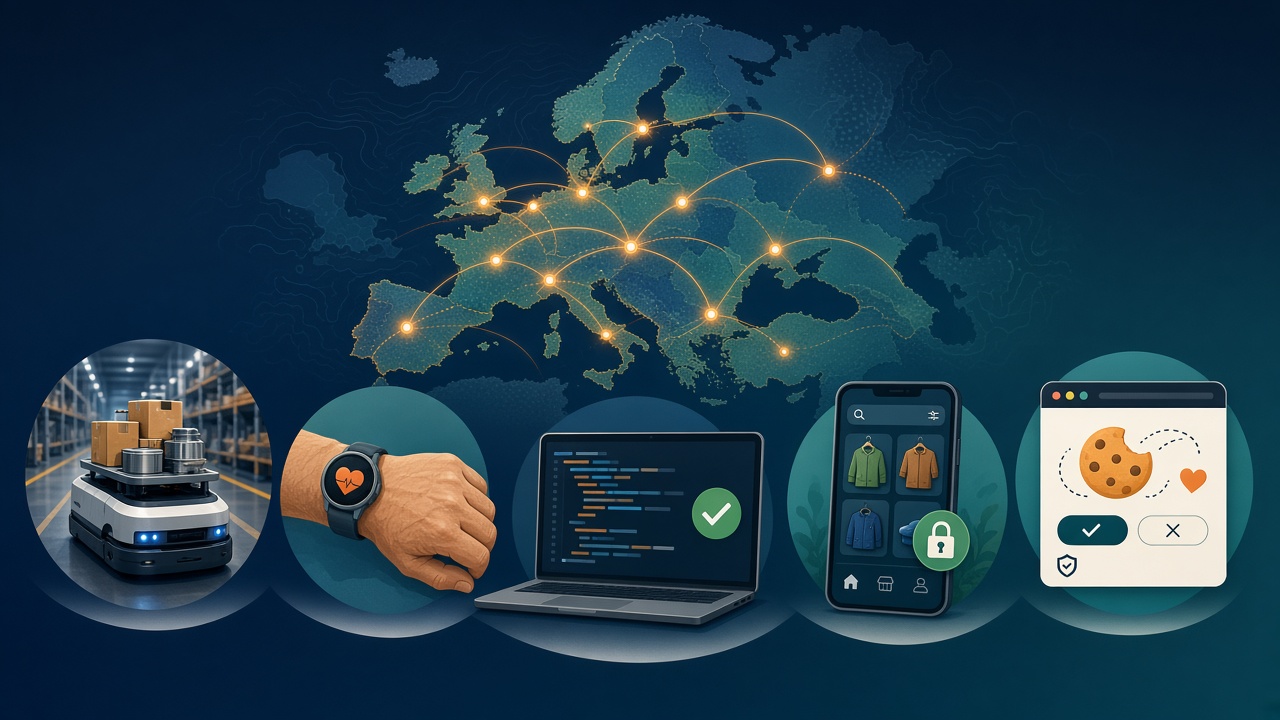
According to the draft seen by Euronews, the blacklist includes making cancellation harder than sign-up, false scarcity claims, pre-ticked add-ons and fake notifications. Subscriptions would need a "terminate the contract here" button, and free trials could no longer roll into paid plans without active consent. In a first for EU consumer law, AI shopping agents would have to disclose sponsored suggestions. The Commission's impact assessment, as reported by Euronews, estimates €88.4bn in avoided consumer losses between 2025 and 2035, against €678m a year in recurring business costs. The regulation would replace the 2005 Unfair Commercial Practices Directive. A Commission spokesperson said it "does not comment on leaks".
Why it matters: Subscription apps, games publishers and e-commerce platforms would no longer be judged case by case; the listed designs would be illegal everywhere in the EU. Germany has already pushed back in an October non-paper, so the text faces a fight in Parliament and Council.
3. Sixteen EU countries have not formally named AI Act enforcers ahead of Friday's Dublin summit
Sixteen EU member states have not formally designated a national authority to enforce the AI Act, and six of them, Austria, Belgium, Bulgaria, Croatia, Slovakia and Hungary, have not picked one at all, more than a year after the August 2025 deadline.
The Commission confirmed the figures, POLITICO reported, as summarised by upday. The other ten have taken only provisional decisions. German Green MEP Sergey Lagodinsky has written to the Commission asking it to open formal proceedings against the laggards. Separately, the deadline for consortia to express interest in the EU's €30bn programme for seven AI compute hubs was pushed back at the end of October, the second delay in a row, because member states need time to finish national budget processes.
Why it matters: Companies building or deploying AI in those countries have no clear national regulator to answer to, while EU leaders meet in Dublin on Friday to talk about reducing dependence on US and Chinese AI. The gap between ambition and enforcement is now on the record.
4. Marble Imaging raises €6m from Cherry Ventures for Germany's first commercial very-high-resolution satellite fleet
Bremen and Berlin-based Marble Imaging has raised €6m in a seed extension led by Cherry Ventures, taking its seed funding to €11.3m, with its first satellite due to launch in early 2027 and 30 planned by 2030.
The round extends a €5.3m seed led by High-Tech Gründerfonds, Startbase reports. The money will go to buying satellites and launch capacity and to an AI analytics platform for defence, civil-security and critical-infrastructure customers. Marble Sat-1 is fully funded, has completed pre-flight testing and is designed to capture sub-metre imagery, according to the company. Chief executive Robert Hook argues Europe depends on non-European providers for this kind of imagery and can be cut off from coverage, citing Ukraine and the Strait of Hormuz.
Why it matters: Sovereign Earth observation has become a defence priority, but Marble has not yet put a satellite in orbit. The funding buys time and hardware; the 2027 launch is the first real proof point.
5. Hlpy gets €12.5m from BNL BNP Paribas billed as Italy's first bank-led venture-debt deal
Milan roadside-assistance scale-up Hlpy has secured €12.5m in venture debt from BNL BNP Paribas, with a first €8.25m tranche backed by a European Investment Fund guarantee, to fund acquisitions and European expansion.
MilanoFinanza describes it as the first use of venture debt in Italy by an Italian bank. Founded in 2020 and led by co-founder and chief executive Valerio Chiaronzi, Hlpy runs a digital platform that manages breakdown and car-assistance services for insurers, rental firms and carmakers. Its shareholders include Nextalia, Alkemia, Techshop, CDP Venture Capital and BNP Paribas BNL Equity Investments, and it is a supplier to Arval, part of the BNP Paribas group.
Why it matters: Non-dilutive growth debt is common in the UK, Germany and France but rare in Italy. If domestic banks start offering it, Italian scale-ups gain a way to fund growth without giving up more equity.