



Breaking Tech Europe: Top 5 – UK MPs Want a Kill Switch for AI, 59 Tech Leaders Demand an EU AI Budget, and Dcubed Raises €27.2m
19/11/2026
29
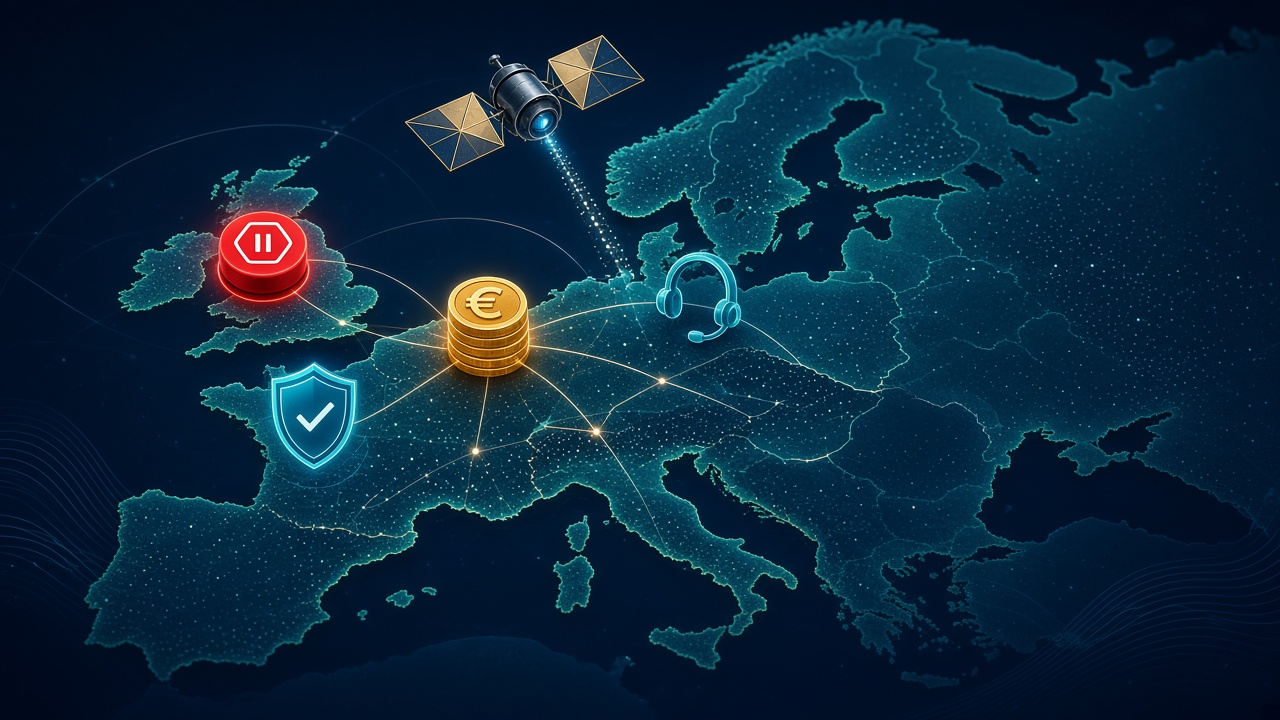
AI-generated illustration of a map of Europe with icons for AI regulation, an EU budget, a satellite, a security shield and a phone headset

British MPs want a regulator that can switch off dangerous AI models, 59 European tech leaders demand an AI line in the EU's next budget, Munich's Dcubed raises €27.2m to industrialise space hardware, Dublin's Disseqt AI raises €7.3m to police AI agents, and a small Dutch town hands its phone line to a Mistral-powered AI agent. Here are the five European tech stories that matter this Thursday, 19 November 2026.

1. UK MPs call for an AI regulator able to halt training, block deployments and suspend services

OpenAI, Google DeepMind, Anthropic and Meta would face a UK watchdog with power to stop high-risk model training, block releases and suspend AI services under an AI Safety and Security Bill proposed by the Commons Business, Innovation, Science and Trade Committee.

The committee's report, Guardrails for Growth: Making AI Safe, identifies ten gaps in Britain's approach, including no mandatory incident reporting, limited access for independent testers and weak protection for whistleblowers, The Register reports. The four companies told MPs they would not release models they considered unsafe, but they do not use the same yardstick. The AI Security Institute would keep testing models while a separate regulator enforces the rules; developers of designated high-risk systems would have to back their safety claims with evidence. "Once some models are released, they cannot reliably be recalled," said committee chair Liam Byrne MP. The committee wants legislation in the next parliamentary session.

Why it matters: The report would move the UK from voluntary testing towards binding pre-release powers. The recommendations are not binding, however, and the government has not committed to the bill, so the real test is whether ministers adopt it.

Source: The Register

2. 59 tech leaders, including the CEOs of DeepL, OVHcloud, ElevenLabs and Lovable, demand a dedicated AI budget from Brussels

DeepL, OVHcloud, ElevenLabs and Lovable's chief executives, Yann LeCun and Nobel laureate Philippe Aghion are among 59 signatories of an open letter calling for a dedicated AI allocation in the EU's 2028-2034 budget, warning that what is not secured now will not exist before 2035.

According to Euronews, the letter, titled "An Urgent Call: Europe Cannot Sleep Through the AI Revolution", sets out five demands: binding simplification of the digital rulebook beyond the first Digital Omnibus and a true "28th regime" so companies can incorporate once for the whole EU; channelling private savings through pension funds and insurers into scale-up funds, with governments as anchor customers; a dedicated AI allocation in the European Competitiveness Fund and the next research framework programme; institutions to keep talent; and a shift "from playing defence to playing offence". The signatories say Europe competes "with a fraction of the capital, the compute, and the scaling capacity of its rivals". Euronews said it had asked the European Commission for comment.

Why it matters: Budget talks for 2028-2034 are under way now. The letter puts named European AI champions on record asking for money and rule changes at the moment when allocations are decided.

Source: Euronews

3. Dcubed raises €27.2m to quadruple space-hardware production in Germany and the US

Dcubed (Germany) has raised a €27.2m Series A+ led by Warsaw Equity Group, with the EIC Fund and HTGF Opportunity Fund, to quadruple manufacturing of its release actuators and solar arrays in Germany and the United States.

Tech.eu reports that Dcubed sells ready-to-order deployment hardware so satellite builders do not have to develop such components themselves. It is also developing ARAQYS, a family of solar arrays. The first design, HALO, is an origami-folded array built with widely available silicon cells; the company says it aims to cut the cost of power in space by one to two orders of magnitude. A 2 kW in-orbit demonstration, ARAQYS-D3, is scheduled for 2027 on a SpaceX rideshare and will also deploy a 10-metre boom manufactured in space. "Demand for our products is going through the roof," said founder and CEO Thomas Sinn. Existing investors BayBG and Expansion also took part.

Why it matters: A Polish-led round backing German production capacity shows that Europe's space supply chain is now raising money to industrialise production, not just to build prototypes.

Source: Tech.eu

4. Disseqt AI raises €7.3m to test and police enterprise AI agents

Disseqt AI (Dublin) has raised €7.3m ($8m) led by Gresham House Ventures, with Sure Valley Ventures, Delta Partners and Enterprise Ireland, to sell AI-agent testing, real-time policy enforcement and audit trails independent of the model providers.

EU-Startups reports that the company, founded in late 2025 by Apoorva Kumar, Manish Atri and Cyril Treacy, tests agents before launch, blocks outputs that breach company policy and keeps evidence for audit. Disseqt says it raised the safe-response rate of a global sports league's fan-engagement agent, used by 80 million fans, from 80% to 99%, and that it works on a large European bank's credit-card programme. Angel investors include senior leaders from OpenAI, Palo Alto Networks, Salesforce and Meta, and cricketer Rahul Dravid. The company is expanding into London.

Why it matters: EU-Startups counts about €111.8m raised by European AI-agent assurance and security companies in 2026 before this round. As agents start taking actions inside business systems, independent oversight is becoming its own market, and regulated buyers are its first customers.

Source: EU-Startups

5. Dutch town Doesburg hands its phone line to "Iris", an AI agent running on Mistral

OpenIris's AI agent "Iris", built on a model from France's Mistral, now answers calls to the Dutch municipality of Doesburg, whose customer contact centre and reception run on just 1.5 FTE. The pilot, running since July, has been extended beyond September.

Dutch public-sector outlet Binnenlands Bestuur reports that Iris says at the start of each call that it is an AI and does not share personal data. It handles some questions itself and transfers others, and speaks 32 languages. Manager Renate Orth said Iris is cheaper than hiring, which matters because Doesburg merges with Zevenaar, Westervoort and Duiven in 2029, and called digital sovereignty an important plus. The results are mixed: the receptionist says Iris regularly misunderstands questions and is slow to transfer calls, a satisfaction survey drew hardly any responses, and there is no structural funding yet to keep Iris after the pilot. OpenIris has also been in a Zuid-Holland province voice-assistant trial since September.

Why it matters: European local governments are starting to put "sovereign" AI on the front line, not only in strategy papers. Doesburg's candid results show both the cost case and the service risks.

Source: Binnenlands Bestuur (Dutch)

Cover image: AI-generated illustration (not a photograph) created for EuropeanTechOnHeels.

Recent

Payhawk raises $280m at $2bn from Goldman Sachs, says it didn't need the money, and will add 100 jobs in Sofia

Technology Due Diligence Before the Deal

Breaking Tech Europe: Top 5 – Genesis AI's $500m robot bet, Temu's DSA breach and 11 states' AI copyright push

Isomorphic Labs raises $5bn, Europe's biggest venture round, but its first AI-designed drug is still only heading for the clinic

Breaking Tech Europe: Top 5 – UK MPs Want a Kill Switch for AI, 59 Tech Leaders Demand an EU AI Budget, and Dcubed Raises €27.2m

19/11/2026
29
AI-generated illustration of a map of Europe with icons for AI regulation, an EU budget, a satellite, a security shield and a phone headset

British MPs want a regulator that can switch off dangerous AI models, 59 European tech leaders demand an AI line in the EU's next budget, Munich's Dcubed raises €27.2m to industrialise space hardware, Dublin's Disseqt AI raises €7.3m to police AI agents, and a small Dutch town hands its phone line to a Mistral-powered AI agent. Here are the five European tech stories that matter this Thursday, 19 November 2026.

1. UK MPs call for an AI regulator able to halt training, block deployments and suspend services

OpenAI, Google DeepMind, Anthropic and Meta would face a UK watchdog with power to stop high-risk model training, block releases and suspend AI services under an AI Safety and Security Bill proposed by the Commons Business, Innovation, Science and Trade Committee.

The committee's report, Guardrails for Growth: Making AI Safe, identifies ten gaps in Britain's approach, including no mandatory incident reporting, limited access for independent testers and weak protection for whistleblowers, The Register reports. The four companies told MPs they would not release models they considered unsafe, but they do not use the same yardstick. The AI Security Institute would keep testing models while a separate regulator enforces the rules; developers of designated high-risk systems would have to back their safety claims with evidence. "Once some models are released, they cannot reliably be recalled," said committee chair Liam Byrne MP. The committee wants legislation in the next parliamentary session.

Why it matters: The report would move the UK from voluntary testing towards binding pre-release powers. The recommendations are not binding, however, and the government has not committed to the bill, so the real test is whether ministers adopt it.

Source: The Register

2. 59 tech leaders, including the CEOs of DeepL, OVHcloud, ElevenLabs and Lovable, demand a dedicated AI budget from Brussels

DeepL, OVHcloud, ElevenLabs and Lovable's chief executives, Yann LeCun and Nobel laureate Philippe Aghion are among 59 signatories of an open letter calling for a dedicated AI allocation in the EU's 2028-2034 budget, warning that what is not secured now will not exist before 2035.

According to Euronews, the letter, titled "An Urgent Call: Europe Cannot Sleep Through the AI Revolution", sets out five demands: binding simplification of the digital rulebook beyond the first Digital Omnibus and a true "28th regime" so companies can incorporate once for the whole EU; channelling private savings through pension funds and insurers into scale-up funds, with governments as anchor customers; a dedicated AI allocation in the European Competitiveness Fund and the next research framework programme; institutions to keep talent; and a shift "from playing defence to playing offence". The signatories say Europe competes "with a fraction of the capital, the compute, and the scaling capacity of its rivals". Euronews said it had asked the European Commission for comment.

Why it matters: Budget talks for 2028-2034 are under way now. The letter puts named European AI champions on record asking for money and rule changes at the moment when allocations are decided.

Source: Euronews

3. Dcubed raises €27.2m to quadruple space-hardware production in Germany and the US

Dcubed (Germany) has raised a €27.2m Series A+ led by Warsaw Equity Group, with the EIC Fund and HTGF Opportunity Fund, to quadruple manufacturing of its release actuators and solar arrays in Germany and the United States.

Tech.eu reports that Dcubed sells ready-to-order deployment hardware so satellite builders do not have to develop such components themselves. It is also developing ARAQYS, a family of solar arrays. The first design, HALO, is an origami-folded array built with widely available silicon cells; the company says it aims to cut the cost of power in space by one to two orders of magnitude. A 2 kW in-orbit demonstration, ARAQYS-D3, is scheduled for 2027 on a SpaceX rideshare and will also deploy a 10-metre boom manufactured in space. "Demand for our products is going through the roof," said founder and CEO Thomas Sinn. Existing investors BayBG and Expansion also took part.

Why it matters: A Polish-led round backing German production capacity shows that Europe's space supply chain is now raising money to industrialise production, not just to build prototypes.

Source: Tech.eu

4. Disseqt AI raises €7.3m to test and police enterprise AI agents

Disseqt AI (Dublin) has raised €7.3m ($8m) led by Gresham House Ventures, with Sure Valley Ventures, Delta Partners and Enterprise Ireland, to sell AI-agent testing, real-time policy enforcement and audit trails independent of the model providers.

EU-Startups reports that the company, founded in late 2025 by Apoorva Kumar, Manish Atri and Cyril Treacy, tests agents before launch, blocks outputs that breach company policy and keeps evidence for audit. Disseqt says it raised the safe-response rate of a global sports league's fan-engagement agent, used by 80 million fans, from 80% to 99%, and that it works on a large European bank's credit-card programme. Angel investors include senior leaders from OpenAI, Palo Alto Networks, Salesforce and Meta, and cricketer Rahul Dravid. The company is expanding into London.

Why it matters: EU-Startups counts about €111.8m raised by European AI-agent assurance and security companies in 2026 before this round. As agents start taking actions inside business systems, independent oversight is becoming its own market, and regulated buyers are its first customers.

Source: EU-Startups

5. Dutch town Doesburg hands its phone line to "Iris", an AI agent running on Mistral

OpenIris's AI agent "Iris", built on a model from France's Mistral, now answers calls to the Dutch municipality of Doesburg, whose customer contact centre and reception run on just 1.5 FTE. The pilot, running since July, has been extended beyond September.

Dutch public-sector outlet Binnenlands Bestuur reports that Iris says at the start of each call that it is an AI and does not share personal data. It handles some questions itself and transfers others, and speaks 32 languages. Manager Renate Orth said Iris is cheaper than hiring, which matters because Doesburg merges with Zevenaar, Westervoort and Duiven in 2029, and called digital sovereignty an important plus. The results are mixed: the receptionist says Iris regularly misunderstands questions and is slow to transfer calls, a satisfaction survey drew hardly any responses, and there is no structural funding yet to keep Iris after the pilot. OpenIris has also been in a Zuid-Holland province voice-assistant trial since September.

Why it matters: European local governments are starting to put "sovereign" AI on the front line, not only in strategy papers. Doesburg's candid results show both the cost case and the service risks.

Source: Binnenlands Bestuur (Dutch)

Cover image: AI-generated illustration (not a photograph) created for EuropeanTechOnHeels.

Recent

© European Tech On Heels - 2026
Made with
Web Wings